2025-09-16 カリフォルニア大学サンタバーバラ校(UCSB)
<関連情報>
- https://news.ucsb.edu/2025/022023/kelp-forests-are-connected-local-beach-ecosystems
- https://www.nature.com/articles/s42003-025-08354-8
補助金依存型沿岸生態系における空間的連結性の解明 Deciphering spatial scales of connectivity in a subsidy-dependent coastal ecosystem
Kyle A. Emery,Jenifer E. Dugan,Robert J. Miller,David M. Hubbard,Jessica R. Madden & Kyle C. Cavanaugh
Communications Biology Published:23 June 2025
DOI:https://doi.org/10.1038/s42003-025-08354-8
Abstract
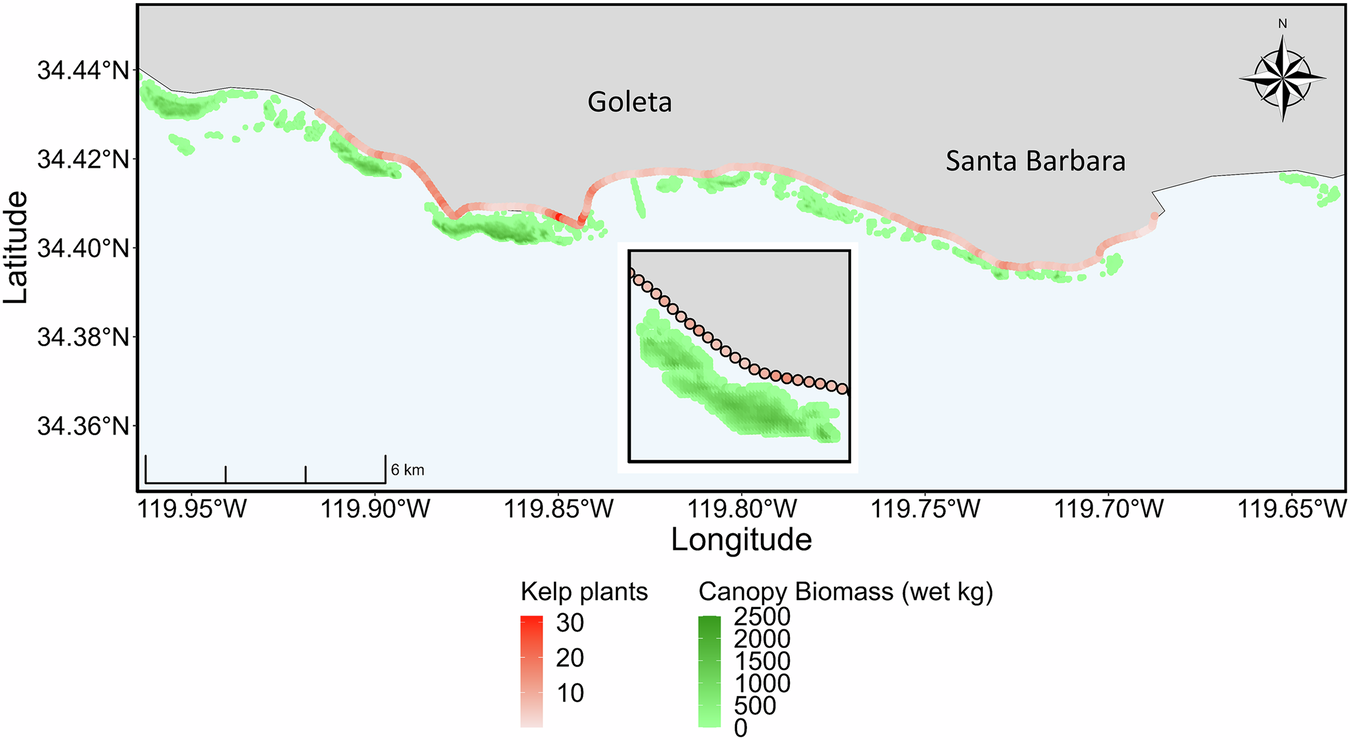
Cross-ecosystem subsidies influence the structure and dynamics of recipient ecosystems and can be sensitive to disturbance. Primary production exported from marine to shoreline ecosystems is among the largest known cross-ecosystem subsidies. However, the spatial scales at which this important connection is manifested are largely unquantified. We used local and regional observations of nearshore kelp canopy biomass and beach kelp wrack inputs to evaluate the scales at which connectivity between kelp forests and beaches is maximized. Regardless of the spatial and temporal scales considered, connectivity was highly local (<10 km) and strongest in winter. Kelp canopy biomass was the primary driver of wrack subsidies, but recipient ecosystem attributes, particularly beach width and orientation, were also important. These drivers of connectivity highlight that disturbance to either ecosystem will have large implications for beach ecosystem productivity. Spatial connectivity can regulate recovery from disturbances such that ecosystem connections must be considered in conservation efforts.