2025-09-10 北海道大学
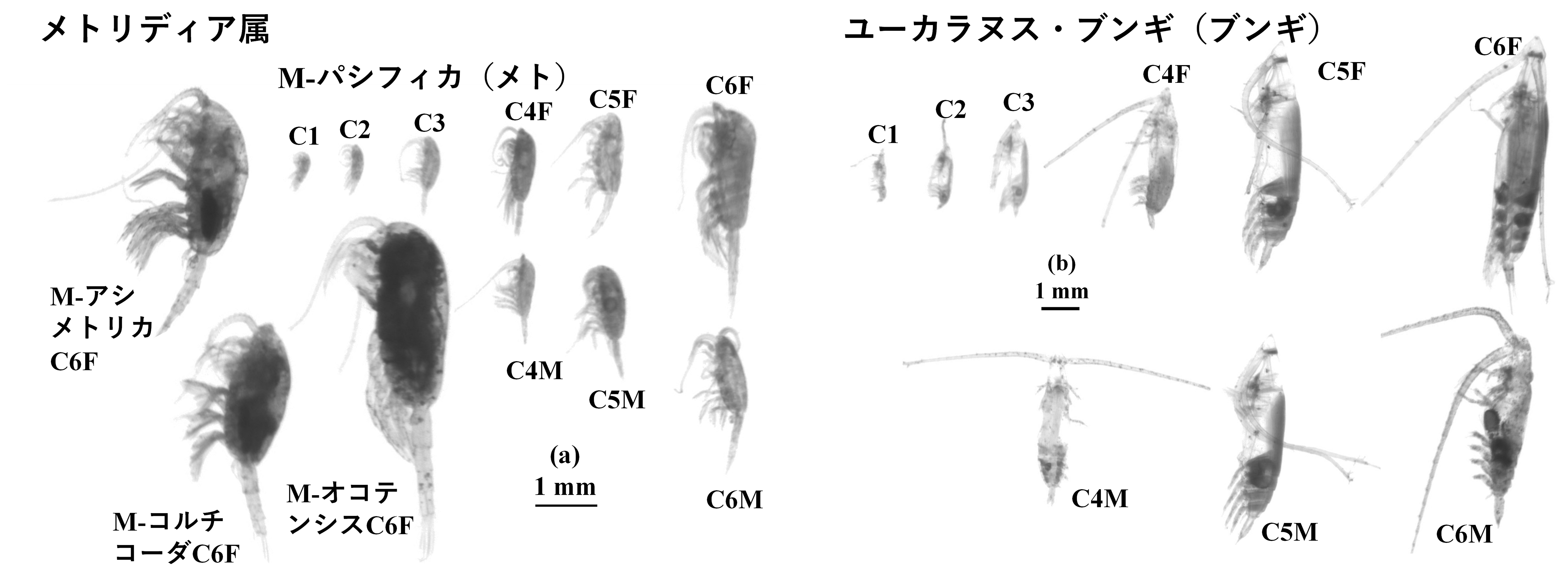
ZooScanにより取得された優占カイアシ類2種の各発育段階の画像データ。左はメトリディア属、右はユーカラヌス・ブンギ。カイアシ類は脱皮して成長し、C1-C6は発育段階。F: 雌、M: 雄。
<関連情報>
- https://www.hokudai.ac.jp/news/2025/09/2-71.html
- https://www.hokudai.ac.jp/news/pdf/250910_pr.pdf
- https://peerj.com/articles/19956/
西部北太平洋亜寒帯域における優占浮遊性カイアシ類2種の個体群構造と鉛直分布の季節変化に関する画像イメージング解析 Analysis of imaging data on seasonal changes in the population structure and vertical distribution of two dominant planktonic copepod species in the western subarctic Pacific
Tian Gao, Atsushi Yamaguchi
PeerJ Published:September 9, 2025
DOI:https://doi.org/10.7717/peerj.19956
Abstract
Traditionally, zooplankton analyses have relied on stereomicroscopes, but recent advancements in imaging analysis have offered significant advantages, including the simultaneous collection of abundance, size, and biovolume data. In this study, formalin-preserved samples were collected from depths of 0 to 1,000 m across four seasons at a station in the western subarctic Pacific, using the imaging device ZooScan. Two dominant copepod genera, Metridia and Eucalanus, were examined for seasonal changes in abundance, biovolume, and diurnal vertical distribution. ZooScan measurements were taken for each developmental stage to obtain information on the equivalent spherical diameter (ESD). Four Metridia species were identified: M. pacifica, M. okhotensis, M. asymmetrica, and M. curticauda. M. pacifica, the dominant species, had an ESD of 2 mm or less, while the other three species exceeded 2 mm. M. pacifica exhibited diurnal migration to surface layers (0–50 m) at night, while the larger species were primarily located in the deeper layer (750–1,000 m) both day and night. Only one species, E. bungii, was identified in the genus Eucalanus, with size cohorts corresponding to each developmental stage. Its vertical distribution was consistent day and night across seasons, but seasonal changes were evident. In October and February, E. bungii was found at depths of 200–500 m. In April, later developmental stages migrated to shallower depths of 50–200 m, while in July, younger stages (C1–C4) were found at 0–50 m, indicating recent reproduction during the spring phytoplankton bloom. Although it was clear that new individuals emerged in July, understanding the dynamics of later stages and generation time was difficult due to overlapping size distributions, particularly in C5 and C6. The differences in vertical distribution between copepod species reveal important ecological trends: M. pacifica performs diel vertical migration (DVM), while E. bungii exhibits seasonal vertical migration (SVM). M. pacifica shows no clear seasonality in population structure, whereas E. bungii has distinct seasonal patterns. This indicates that both species reproduce near the surface, but E. bungii follows annual life cycles due to its larger size, while M. pacifica reproduces opportunistically throughout the year. Using ZooScan offers significant advantages for studying copepod ecology, enabling precise estimations of ecological fluxes—such as feeding, production, and egestion—through accurate measurements of body sizes and masses. Adopting these methods will enhance our understanding of copepod populations and their ecosystems.