2025-09-10 イリノイ大学アーバナ・シャンペーン校
<関連情報>
- https://aces.illinois.edu/news/pretreatment-methods-bring-second-gen-biofuels-oilcane-closer-commercialization
- https://pubs.rsc.org/en/content/articlelanding/2025/se/d5se00519a
バイオエタノール生産および遺伝子組み換えサトウキビからの脂質回収における新興バイオマス前処理技術の産業的潜在性の評価 Evaluating the industrial potential of emerging biomass pretreatment technologies in bioethanol production and lipid recovery from transgenic sugarcane
Narendra Naik Deshavath,Mounika Durga Nenavath,William Woodruff,Baskaran Kannan,Hui Liu,Venkataramana R. Pidatala,Paul Wolski,Dan Xie,Kallysa Taylor,Yaoping Zhang,Trey K. Sato, Alberto Rodriguez, John Shanklin,Fredy Altpeter and Vijay Singh
Sustainable Energy & Fuels Published:23 Jul 2025
DOI:https://doi.org/10.1039/D5SE00519A
Abstract
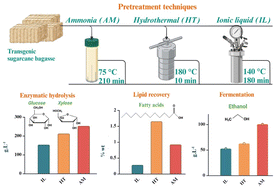
The selection of pretreatment methods is critical to achieving high product yields during bioconversion of lignocellulosic biomass. Hydrothermal, soaking-in-aqueous ammonia, and ionic liquid pretreatment methods are viable candidates for minimizing sugar decomposition, permitting the effective hydrolysis of structural carbohydrates, and producing a fermentable substrate suitable for achieving industrial ethanol titers and yields. In this study, the effect of these three pretreatment methods on non-modified sugarcane cultivar CP88-1762 and two transgenic lipid-accumulating sugarcane lines, oilcane 1565 and oilcane 1566, were investigated and compared in terms of lipid recovery, sugar yield, and ethanol yields within the lignocellulosic biomass conversion pipeline. Fed-batch enzymatic hydrolysis at high solid loading yielded hydrolysates capable of supporting industrial bioethanol titers across all conditions. The highest sugar yields were obtained on ammonia-pretreated biomass hydrolysate (253.73 g L−1), followed by hydrothermally pretreated hydrolysate (213.10 g L−1) and ionic liquid-pretreated hydrolysate (154.20 g L−1). Commercially viable ethanol titers of 100.62 g L−1, 64.47 g L−1, and 52.95 g L−1 were achieved from ammonia, hydrothermal, and ionic liquid pretreated hydrolysate with the corresponding ethanol productivities of 2.08 g L−1 h−1, 0.53 g L−1 h−1, and 0.36 g L−1 h−1. The lower acetic acid concentration in ammonia-pretreated hydrolysate may have enhanced its fermentability relative to the hydrothermal pretreatment condition, as indicated by the differences in ethanol titer and productivity. Lower sugar yields and ethanol productivities under the ionic liquid conditions likely resulted from the inhibitory effect of cholinium lysinate. Oilcane 1565 and oilcane 1566 bagasse accumulated over 16- and 3 times higher lipids than the non-modified sugarcane CP88-1762. The total fatty acid content in the oilcane samples was reduced in ammonia and ionic liquid-pretreated bagasse relative to the hydrothermal pretreatment condition. While all pretreatment techniques tested are industrially viable, the observed differences in titer, productivity, and lipid content indicate that careful selection and validation of upstream processing methods can contribute to improved economic and environmental outcomes.