2025-09-05 パシフィック・ノースウェスト国立研究所(PNNL)
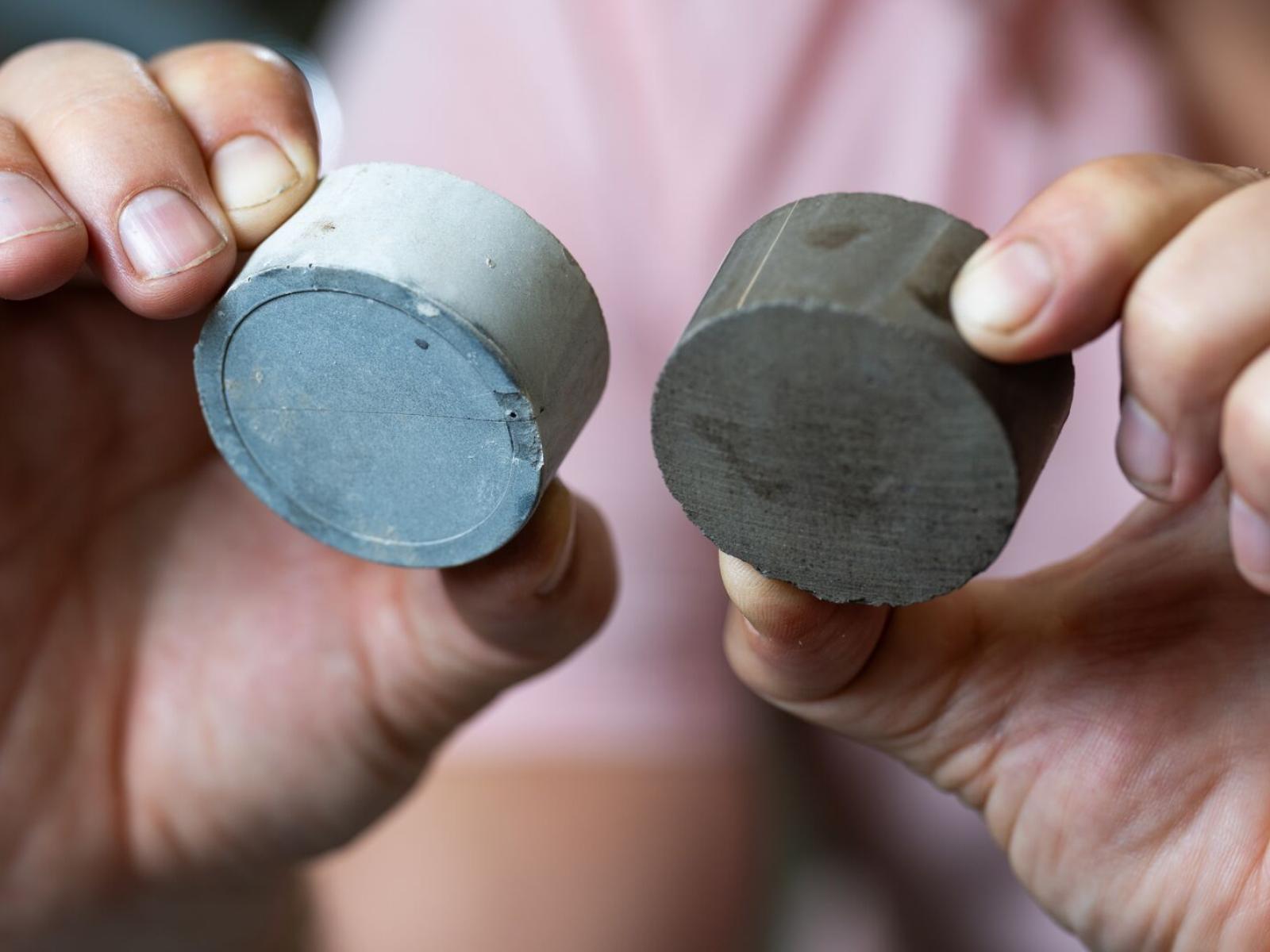
Researchers at PNNL are using a waste production from hydrothermal liquefaction—algal biochar—as a supplementary material for cement (right) that compares favorably to cement made with conventional, costlier supplementary materials (right).
(Photo by Andrea Starr | Pacific Northwest National Laboratory)
<関連情報>
- https://www.pnnl.gov/publications/pnnl-turns-algae-fuel-and-cement
- https://pubs.acs.org/doi/10.1021/acssuschemeng.4c09568
バイオ燃料生産副産物である藻類バイオチャールをセメント質材料補強材として利用する可能性 Feasibility of Algal Biochar, a Byproduct of Biofuel Production, as a Supplemental Cementitious Material
Lan Li,Zihao Li,Chao Zeng,Jing Wu,Yuntian Teng,Mark Rhodes,Jarrod Crum,Andrew Schmidt,Peter J. Valdez,and Carlos A. Fernandez
ACS Sustainable Chemistry & Engineering Published: June 11, 2025
DOI:https://doi.org/10.1021/acssuschemeng.4c09568
Abstract

Algal biochar, as the solid residue of biofuel production from algal biomass, is reported to explore disposition options, aiming to lessen the liability or obstacles to biofuel production processes. However, landfills and open combustion lead to adverse environmental impacts. One way to add value to such wastes is to use them as admixtures in cementitious construction materials. This study aims to investigate the feasibility of algae-derived biochar as supplementary cementitious materials (SCM) at different water contents and mixture ratios. Algal biochar-cement composites were prepared with different algal biochar content as well as different water-to-cement (w/c) ratios, and the surface area, morphology, elemental, and mineralogical composition were characterized. To compensate for the high-water absorption of algal biochar, a small concentration of a superplasticizer was used since higher w/c ratios negatively impact strength. The mechanical performance of algal biochar-cement composites is compared with control composites using commercial silica fume as a typical commercial SCM. The findings suggest that algal biochar is a promising candidate to replace commercial SCM, like silica fume, since algal biochar-cement composites can reach comparable compressive strength and Young’s modulus to commercial pozzolan-cement materials with the same w/c ratio, though at later curing times, 33 days. Although the tensile strength of algal biochar-cement composites is statistically similar at 7 days, it is significantly lower at later curing times, and further investigation is required to improve this property. Algal biochar-based cement binders showed comparable embodied carbon to silica fume-based cement binders based on a cradle-to-gate lifecycle analysis. However, the ability of algal biochar to absorb large volumes of CO2 over short periods of time, as measured in this study, makes this novel SCM an excellent alternative to reduce the embodied carbon of concrete structures cradle-to-grave at 1/10 of the cost. Valorization of algae-derived solid waste provides great potential to reduce embodied carbon and brings credit to biofuel production and concrete-based construction.