2025-09-03 中国科学院(CAS)
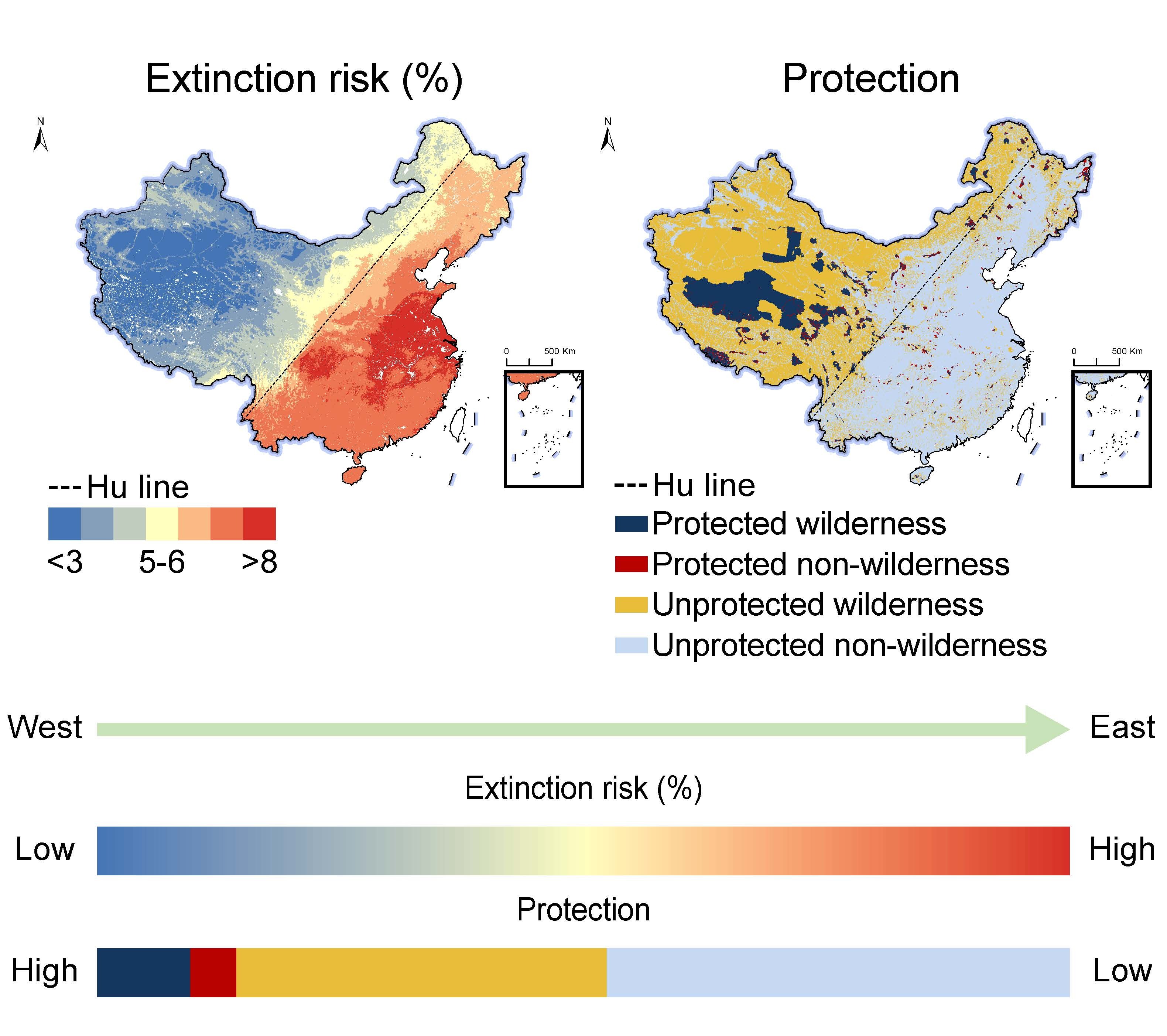
Extinction Risk–Protection Mismatch in China’s Flora. (Image by SHEN Guozhen)
<関連情報>
- https://english.cas.cn/newsroom/research_news/life/202509/t20250901_1051850.shtml
- https://www.cell.com/one-earth/abstract/S2590-3322(25)00255-6
動的生息地評価による中国植物相の隠れた絶滅リスクの解明 Revealing hidden extinction risks in China’s flora through dynamic habitat assessment
Tianyuan Lan ∙ Stuart L. Pimm ∙ Jonathan M. Chase ∙ … ∙ Wenting Xu ∙ Zongqiang Xie ∙ Guozhen Shen
One Earth Published:September 3, 2025
DOI:https://doi.org/10.1016/j.oneear.2025.101429
Science for society
Biodiversity loss is a pressing global issue. Our findings address the ongoing decline in plant biodiversity across China, home to 35,000 species—∼8% of the world’s total. The study reveals a troubling disparity between areas at high risk of extinction and current conservation efforts, particularly in eastern China. Such losses could cause far-reaching harm to ecosystem health, food security, and human well-being. The findings call for urgent, targeted conservation strategies to prevent further biodiversity loss. These strategies are crucial for maintaining ecological balance and ensuring the continued provision of ecosystem services that support human life. In the long term, this research could influence global conservation policies, emphasizing the need for a more equitable distribution of protective efforts to safeguard biodiversity and, by extension, the health and prosperity of societies worldwide. By bridging ecological science with policy and community action, this work aspires to transform our approach to conservation in the face of growing environmental challenges.
Highlights
- Nationwide plant extinction risks rise by 3.91% and native habitats lose 2.81%
- IUCN Red List fails to capture the full spectrum of plant biodiversity loss
- Protection amplified the effectiveness of wilderness in reducing extinction risk
- Uneven protection landscape leaves certain species groups at heightened risk
Summary
The loss of biodiversity is irreversible and represents one of humanity’s greatest sustainability challenges. It has severe consequences for ecosystems and human well-being and requires global action. China, a global biodiversity hotspot, has experienced rapid habitat loss due to land-use change. Yet, current assessments, such as the IUCN Red List, suffer from incomplete coverage and fail to account for dynamic changes in habitat. This creates critical gaps in conservation planning. Here, we integrate species composition dissimilarities with satellite-derived land-use changes to quantify extinction risks across China. Our findings reveal a nationwide increase in extinction risk (3.91%) alongside a decline in habitat (2.81%). Current protected areas disproportionately prioritize lower-risk western regions, while IUCN assessments often overlook high-risk areas in human-modified landscapes. Our results establish a framework for quantifying extinction risks driven by dynamic habitat loss—a critical dimension that traditional IUCN metrics neglect. We provide actionable insights to advance sustainable development goals.