2025-08-28 マサチューセッツ工科大学(MIT)
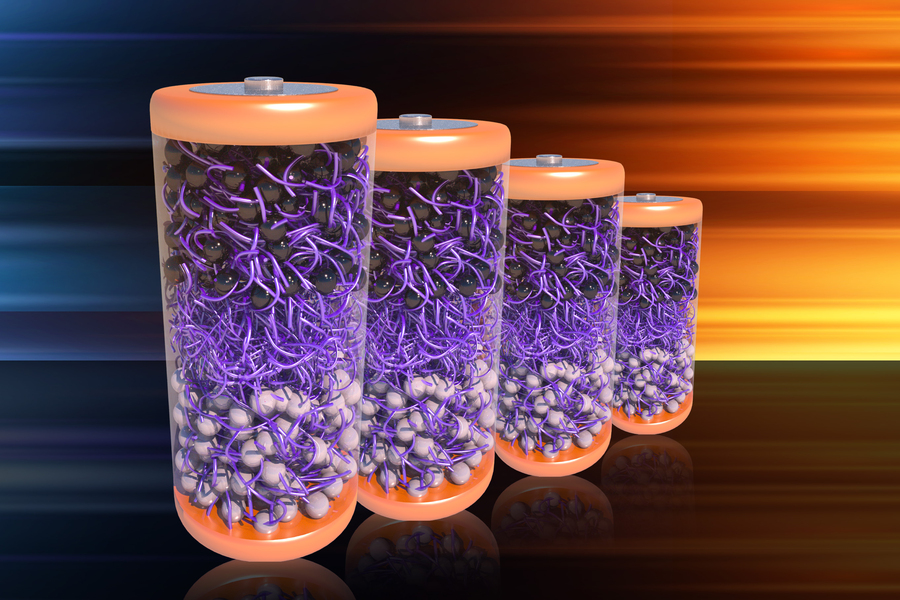
A depiction of batteries made with MIT researchers’ new electrolyte material, which is made from a class of molecules that self-assemble in water, named aramid amphiphiles (AAs), whose chemical structures and stability mimic Kevlar.
Credits:Image: Courtesy of the researchers, edited by MIT News
<関連情報>
- https://news.mit.edu/2025/new-self-assembling-material-could-be-key-recyclable-ev-batteries-0828
- https://www.nature.com/articles/s41557-025-01917-6
リサイクル可能な固体電池電解質のための可逆的自己組織化小分子 Reversible self-assembly of small molecules for recyclable solid-state battery electrolytes
Yukio Cho,Cole D. Fincher,Guillaume Lamour,Ty Christoff-Tempesta,Xiaobing Zuo,Yet-Ming Chiang &Julia H. Ortony
Nature Chemistry Published:28 August 2025
DOI:https://doi.org/10.1038/s41557-025-01917-6
Abstract
Performance often overshadows recyclability in contemporary battery designs, leading to sustainability challenges. Preemptive strategies integrating recyclable chemistry from the outset are thus increasingly critical for addressing the complexities in conventional recycling. Here we harness bio-inspired molecular self-assembly to create inherently recyclable battery materials. We use aramid amphiphiles that self-assemble in water through strong, collective hydrogen bonding and π–π stacking, forming air-stable, high-aspect-ratio nanoribbons with gigapascal-level stiffness. When processed into bulk solid-state electrolytes, these nanoribbons retain their ordered molecular arrangement and exhibit total conductivities of 1.6 × 10⁻⁴ S cm−1 at 50 °C, Young’s moduli of 70 MPa and toughness values of 1 MJ m−3, despite being stabilized solely by reversible non-covalent bonds. We further demonstrate clean separation of battery components by exposing used cells to an organic solvent, which disrupts the non-covalent cohesion and reverts all battery components to their original forms. This study underscores the potential of molecular self-assembly for specialized recyclable designs in energy storage applications.