2025-08-29 中国科学院(CAS)
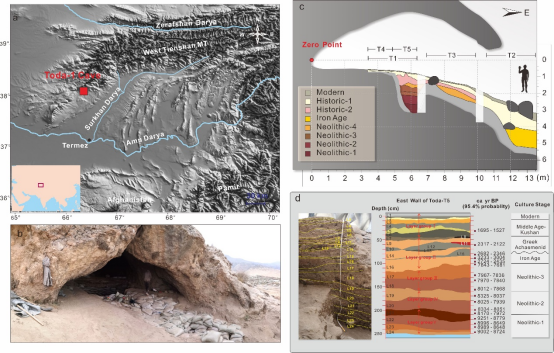
Location of Toda No.1 Cave in Uzbekistan, stratigraphic distribution, entrance photo and chronological stratigraphy. (Image by IVPP)
<関連情報>
- https://english.cas.cn/newsroom/research_news/life/202508/t20250829_1051663.shtml
- https://www.pnas.org/doi/10.1073/pnas.2424093122
中央アジアの丘陵地帯における9,000年前の大麦消費 9,000-year-old barley consumption in the foothills of central Asia
Xinying Zhou, Robert N. Spengler, Bahediyoh Sayfullaev, +19 , and Xiaoqiang Li
Proceedings of the National Academy of Sciences Published:August 25, 2025
DOI:https://doi.org/10.1073/pnas.2424093122
Significance
Here, we present archaeobotanical data for ancient barley grains in association with sickle blades and grinding stones from the cave of Toda in the foothills of southern Uzbekistan. This finding helps shed light on one of the greatest mysteries in central Asian archaeology—how did the Kelteminar people live? We complement our data with a suite of radiocarbon dates, a detailed palynological study, an analysis of wood charcoal remains, and a detailed analysis of all aspects of the archaeological remains. These data, collectively, paint the clearest picture thus far of the prehistory of this poorly studied corner of the ancient world.
Abstract
Scholars are increasingly favoring models for the origins of agriculture that involve a protracted process of increasing interdependence within a series of mutualistic relationships between humans and plants, as opposed to a rapid single event or innovation. Nonetheless, these scholars continue to debate over when people first started foraging for grass seeds, when they began to readily utilize sickles, how prominent the early selection pressures were, and when the first traits of domestication fully introgressed into the cultivated grass population. Here, we present complementary archaeobotanical and archaeological (stone tool) evidence for cereal foragers from Toda-1 Cave in the Surkhan Darya, dating to 9200 cal BP. We conclude that early Holocene foragers were processing grains along with nuts and fruits as far north as the rich river valleys of southern Uzbekistan. These data expand the known range that preagricultural cereal foragers covered in the early Holocene, adding to our understanding of the cultural processes that led to farming. Additionally, we present the earliest evidence for people interacting with the progenitors for pistachios and apples (or a close apple relative). The complex foraging behaviors that led to cultivation were being undertaken by people during the early Holocene across a wider area of Eurasia than previously thought.