2025-08-28 アリゾナ大学
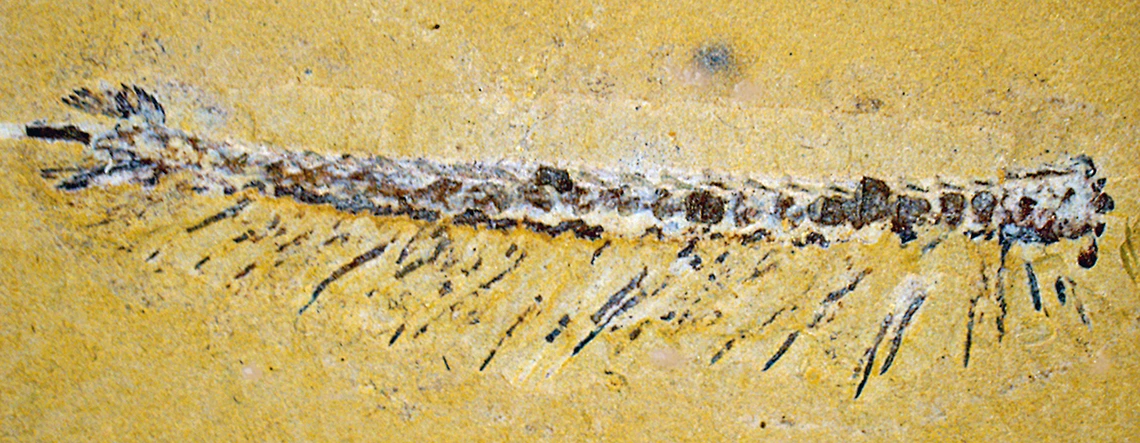 One of several Jianfengia fossil specimens: The animal’s body plan is extremely simple, consisting of numerous identical segments. However, its head is like that of a more modern crustacean, with eyes on stalks and frontal simple eyes. The head is about 2 millimeters wide (less than one tenth of an inch).
Nick Strausfeld/Department of Neuroscience
<関連情報>
- https://news.arizona.edu/news/ancient-signpost-minute-fossils-tell-big-story-about-arthropod-evolution
- https://www.nature.com/articles/s41467-025-62849-w
カンブリア紀化石Jianfengia multisegmentalisの脳解剖学が真節足動物の系統発生を解明 Brain anatomy of the Cambrian fossil Jianfengia multisegmentalis informs euarthropod phylogeny
Nicholas J. Strausfeld,David R. Andrew,Xianguang Hou & Frank Hirth
Nature Communications Published:28 August 2025
DOI:https://doi.org/10.1038/s41467-025-62849-w
Abstract
Cambrian fossils from the Chengjiang biota demonstrate that over half a billion years ago early stem euarthropods existed coevally with representatives of already recognizable crown groups. Prominent stem taxa were Fuxianhuia protensa and Alalcomenaeus whose cerebral and ganglionic traits identify them as, respectively, stem mandibulates and stem chelicerates. Here we report on the visual systems and brain of the enigmatic lower Cambrian euarthropod Jianfengia multisegmentalis, which reveals neural traits suggestive of Pancrustacea despite its possession of ‘great appendages’. As occur in pancrustaceans, three nested optic neuropils are resolved in the eyestalks of Jianfengia, together with rostral ocelli and their associated nerves supplying a discrete forebrain region. Sutured eyestalks typifying crown Malacostraca provide compound eyes populated by ommatidia revealing structures suggesting cone-building cells. These and other neuroanatomical traits provide a powerful tool for resolving euarthropod relationships. Phylogenetic analyses deploying neural traits of Jianfengia, other Cambrian taxa, and extant Euarthropoda elucidate the status of Jianfengia as sister to total Mandibulata and reveal the short-bodied ‘great appendage’ Leanchoiliidae as sister to total Chelicerata. Together these data provide independent evidence for a 23 year-old proposition that ‘great appendage’ morphology defines the early stem from which derived the two branches of the euarthropod tree of life.