2025-08-22 アリゾナ大学
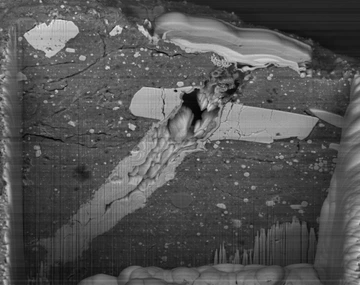
This scanning electron microscope image shows a micrometeorite impact crater in a particle of asteroid Bennu material. NASA
<関連情報>
- https://news.arizona.edu/news/asteroid-bennu-time-capsule-materials-bearing-witness-its-origin-and-transformation-over
- https://www.nature.com/articles/s41550-025-02631-6
- https://www.nature.com/articles/s41561-025-01741-0
- https://www.nature.com/articles/s41561-025-01745-w
ベンヌの親小惑星に集積された物質の多様性と起源 The variety and origin of materials accreted by Bennu’s parent asteroid
J. J. Barnes,A. N. Nguyen,F. A. J. Abernethy,K. Bajo,D. V. Bekaert,E. Bloch,G. A. Brennecka,H. Busemann,J. S. Cowpe,S. A. Crowther,M. Ek,L. J. Fawcett,M. A. Fehr,I. A. Franchi,E. Füri,J. D. Gilmour,M. M. Grady,R. C. Greenwood,P. Haenecour,N. Kawasaki,P. Koefoed,D. Krietsch,L. Le,K. M. Liszewska,… D. S. Lauretta
Nature Astronomy Published:22 August 2025
DOI:https://doi.org/10.1038/s41550-025-02631-6
Abstract
The first bodies to form in the Solar System acquired their materials from stars, the presolar molecular cloud and the protoplanetary disk. Asteroids that have not undergone planetary differentiation retain evidence of these primary accreted materials. However, geologic processes such as hydrothermal alteration can dramatically change their bulk mineralogy, isotopic compositions and chemistry. Here we analyse the elemental and isotopic compositions of samples from asteroid Bennu to uncover the sources and types of material accreted by its parent body. We show that some primary accreted materials escaped the extensive aqueous alteration that occurred on the parent asteroid, including presolar grains from ancient stars, organic matter from the outer Solar System or molecular cloud, refractory solids that formed close to the Sun, and dust enriched in neutron-rich Ti isotopes. We find Bennu to be richer in isotopically anomalous organic matter, anhydrous silicates, and light isotopes of K and Zn than its closest compositional counterparts, asteroid Ryugu and Ivuna-type (CI) carbonaceous chondrite meteorites. We propose that the parent bodies of Bennu, Ryugu and CI chondrites formed from a common but spatially and/or temporally heterogeneous reservoir of materials in the outer protoplanetary disk.
ベンヌのサンプルの熱水変質の鉱物学的証拠 Mineralogical evidence for hydrothermal alteration of Bennu samples
T. J. Zega,T. J. McCoy,S. S. Russell,L. P. Keller,Z. Gainsforth,S. A. Singerling,V. R. Manga,C. Harrison,G. Libourel,B. S. Prince,K. Thomas-Keprta,A. King,M. Portail,V. Guigoz,V. Tu,L. Le,M. Thompson,M. C. Benner,N. A. Kerrison,J. J. Barnes,I. Ong,P. Haenecour,L. Chaves,L. Smith,… D. S. Lauretta
Nature Geoscience Published:22 August 2025
DOI:https://doi.org/10.1038/s41561-025-01741-0
Abstract
Samples of asteroid (101955) Bennu delivered by the OSIRIS-REx mission offer the opportunity to study pristine planetary materials unchanged by exposure to the terrestrial environment. Here we use a combination of X-ray diffraction and various electron microscopy techniques to explore the detailed mineralogy of Bennu samples and determine the alteration history of the planetesimal protolith from which they originated. The samples consist largely of hydrated sheet-silicate minerals, namely nanoscale serpentine and saponite of varied grain size, which are decorated with micro- to nanoscale Fe-sulfides, magnetite and carbonates. We observe sheet silicates parallel and normal to sulfide surfaces and as inclusions in sulfides; sulfur-rich veins transecting the sheet-silicate matrix; zoned carbonates and phosphates and sulfide and magnetite grains exhibiting embayment. The mineralogical evidence indicates alteration of accreted minerals by a fluid that evolved with time, leading to etching, dissolution and reprecipitation. Sulfide compositions indicate alteration at ~25 °C, similar to conditions inferred for asteroid (162173) Ryugu and Ivuna-type (CI) chondrite meteorites. The fluid probably evolved from neutral to alkaline, culminating with the precipitation of highly soluble salts. We conclude that Bennu’s protolith comprised mainly nanometre to micrometre silicates, with fewer chondrules and calcium–aluminium-rich inclusions than those of most chondrite groups.
ベンヌ小惑星サンプルにおける宇宙風化の影響 Space weathering effects in Bennu asteroid samples
L. P. Keller,M. S. Thompson,L. B. Seifert,L. E. Melendez,K. L. Thomas-Keprta,L. Le,C. J. Snead,K. C. Welten,K. Nishiizumi,M. W. Caffee,J. Masarik,H. Busemann,D. Krietsch,C. Maden,Z. Rahman,C. A. Dukes,E. A. Cloutis,Z. Gainsforth,S. A. Sandford,D. N. DellaGiustina,H. C. Connolly Jr. & D. S. Lauretta
Nature Geoscience Published:22 August 2025
DOI:https://doi.org/10.1038/s41561-025-01745-w
Abstract
The OSIRIS-REx mission deployed contact pad samplers to collect regolith from the uppermost surface of the asteroid Bennu that was exposed to the space environment. Space weathering processes, dominated by micrometeoroid impacts and solar irradiation, modify the mineralogy and chemistry of exposed surfaces to produce solar wind-amorphized layers on clays, metallic whiskers associated with high temperature melts and Fe nitride created by the reaction of indigenous N-bearing gases with space-weathered surfaces. Here, we use cosmogenic noble gases and radionuclides to suggest that the upper metre of Bennu’s regolith has been exposed to cosmic rays for 2–7 million years, consistent with remote sensing observations indicating that the asteroid’s surface is dynamic and regularly modified by mass movement. Solar energetic particle track and microcrater densities constrain the space weathering spectral changes observed in Hokioi crater to <50,000 years. These spectral changes are driven largely by the accumulation of impact melt deposits on particle surfaces, although compositional or grain size effects may also occur. Comparison of Bennu samples with those collected from the asteroids Ryugu and Itokawa suggest that micrometeoroid impacts might play a more active and rapid role in the space weathering of asteroidal surfaces than was initially suggested, particularly for carbonaceous bodies.