2025-08-12 中国科学院(CAS)
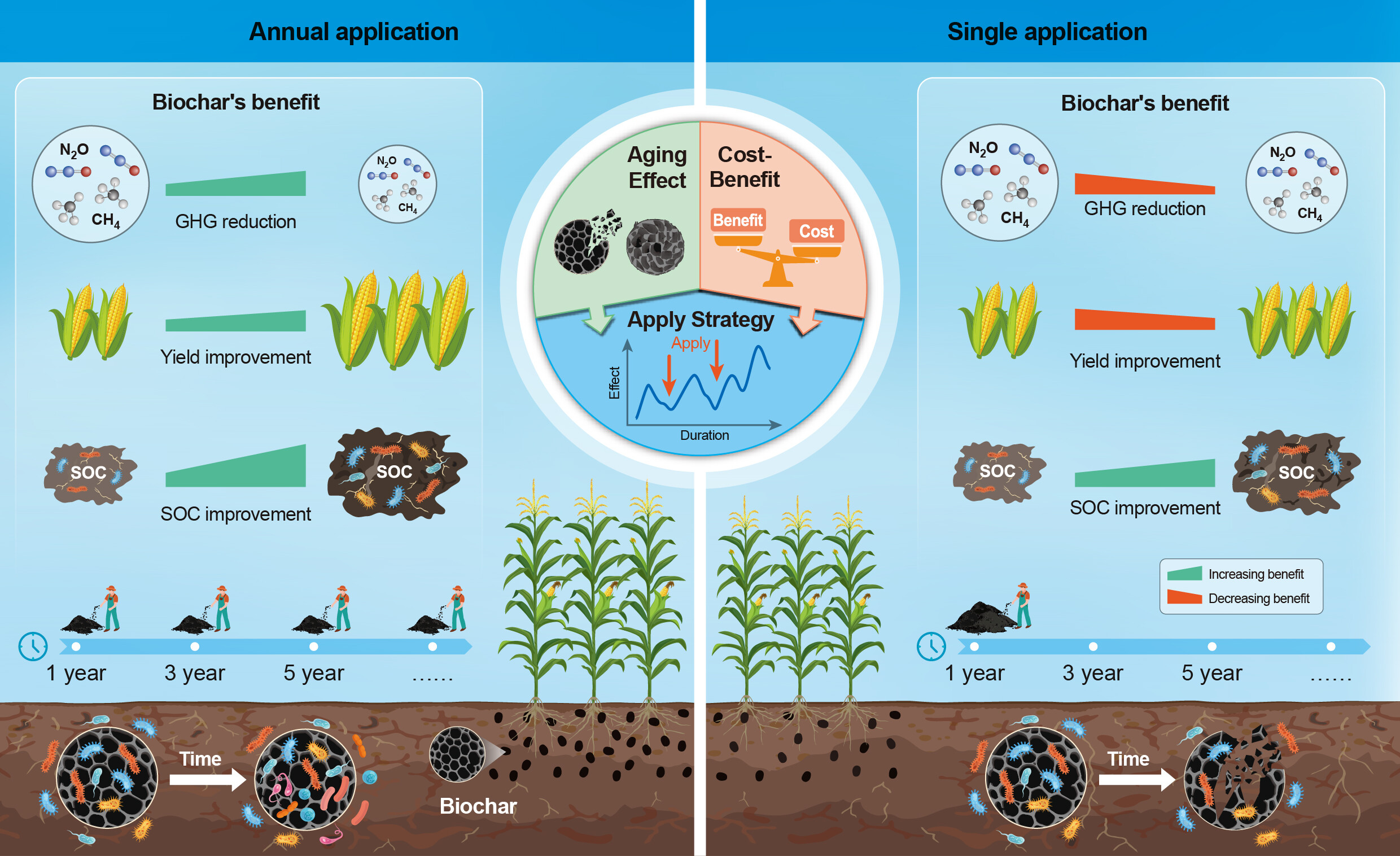
Long-term benefits of biochar application on food security and climate change mitigation (Image by YAN Xiaoyuan’s team)
<関連情報>
- https://english.cas.cn/newsroom/research_news/earth/202508/t20250818_1050909.shtml
- https://www.pnas.org/doi/10.1073/pnas.2509237122
長期的なバイオチャール応用による食料安全保障と気候変動緩和の持続的な効果 Sustained benefits of long-term biochar application for food security and climate change mitigation
Jingrui Yang, Longlong Xia, Kees Jan van Groenigen, +19 , and Xiaoyuan Yan
Proceedings of the National Academy of Sciences Published:August 11, 2025
DOI:https://doi.org/10.1073/pnas.2509237122
Significance
Biochar application is proposed as a promising strategy to improve food security and mitigate climate change. Whether these agronomic and environmental benefits are sustained under long-term biochar application remains unknown, especially considering the potential adverse effects of its continuous application in the soil environment. We analyzed an expansive global dataset and results from 29 global long-term field experiments (4 to 12 y) and found that long-term annual applications sustain and even enhance the benefits on crop yields, GHG mitigation, and SOC sequestration. In contrast, those benefits diminish over time under single applications. Future research should focus on optimizing the application strategies across diverse soil and climate conditions to maximize biochar’s contributions to global food security and climate change mitigation.
Abstract
Biochar application offers significant potential to enhance food security and mitigate climate change. However, most evidence stems from short-term field experiments (≤3 y), leaving uncertainty about the long-term sustainability of these benefits, especially with annual biochar additions to soils. To address this knowledge gap, we analyzed a global dataset from 438 studies (3,229 observations) and found that long-term annual biochar application (≥4 y) not only sustains but often enhances its benefits. These include improved crop yields (+10.8%), reductions in CH4 (–13.5%) and N2O (–21.4%) emissions, and increased soil organic carbon content (+52.5%). In contrast, these benefits tend to diminish over time with single biochar applications due to the aging effect of biochar. Results from 29 global long-term experiments (4 to 12 y) confirm these sustained benefits for crop yield and greenhouse gas mitigation, although the magnitude of effects varies with soil properties, climate, and management practices. To maximize biochar’s long-term benefits for global food security and climate change mitigation, it is essential to develop viable strategies, such as applying biochar at intervals of several years while tailoring practices to local soil, climate, and cropping conditions.