2025-08-18 中国科学院(CAS)
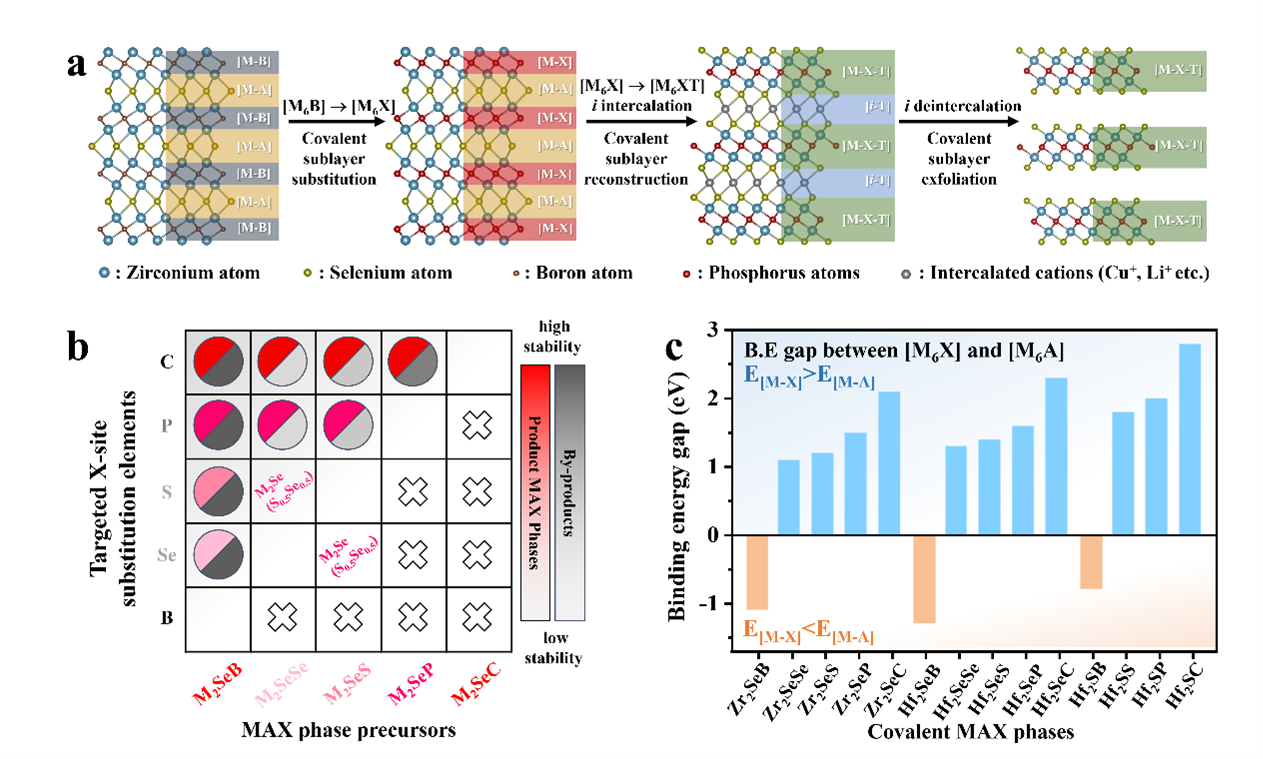 Structural editing strategy from covalent MAX phase to TMXC. (Image by NIMTE)
<関連情報>
- https://english.cas.cn/newsroom/research_news/chem/202508/t20250815_1050486.shtml
- https://www.nature.com/articles/s44160-025-00855-y
共有結合性MAX相のサブ層編集によるナノラミネート型早期遷移金属化合物の合成 Sublayer editing of covalent MAX phase for nanolaminated early transition metal compounds
Ziqian Li,Ke Chen,Xudong Wang,Kan Luo,Lei Lei,Mian Li,Kun Liang,Degao Wang,Shiyu Du,Xiaoping Ouyang,Zhifang Chai & Qing Huang
Nature Synthesis Published:18 August 2025
DOI:https://doi.org/10.1038/s44160-025-00855-y
Abstract
Two-dimensional transition metal carbides/nitrides, known as MXenes, are interesting for energy applications. They are typically synthesized by etching the weak metallic M–A sublayer in MAX phases while the strong covalent M–X sublayer maintains the structure. However, certain MAX phases with non-metal A sites feature fully covalent M–A/M–X sublayers, preventing etching synthesis. Here we discovered that the covalent-bond-type M–A and M–X sublayers show different reactivities in a high-temperature molten state. By utilizing this difference in reactivity, we can structurally modify these covalent sublayers, enabling the substitution of elements at the X site, converting non-metal A-site atoms in non-van der Waals MAX phases into surface atoms in van der Waals layered materials. This results in a family of early transition metal Xide chalcogenides (TMXCs) with lattice characteristics of both MXenes and transition metal chalcogenides. Using electron-donor chemical scissors, these TMXC layered materials can be exfoliated into monolayer nanosheets. The atomic configurations of each atom in these monolayer TMXCs are the same as those of conventional MXenes, but the oxidation states of the M-site atoms can be regulated by both X-site atoms and intercalated cations. These materials may find applications in electrochemical energy storage and surface catalysis.