
2025-08-15 中国科学院(CAS)
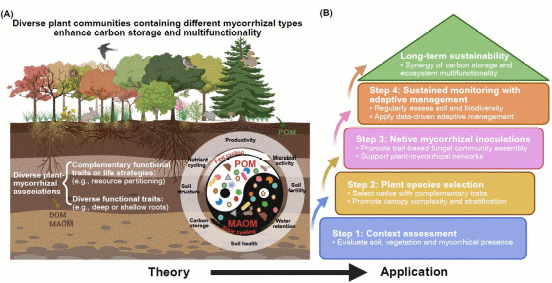
Conceptual framework for synergistic soil carbon and ecosystem restoration via plant-mycorrhizal integration. (Imaged by LI Tengteng et al.)
<関連情報>
- https://english.cas.cn/newsroom/research_news/life/202508/t20250815_1050490.shtml
- https://www.cell.com/trends/ecology-evolution/fulltext/S0169-5347(25)00188-0
菌根の同盟者:森林の炭素と多機能的な回復の相乗効果 Mycorrhizal allies: synergizing forest carbon and multifunctional restoration
Tengteng Li (李腾腾) ∙ Richard P. Phillips ∙ Matthias C. Rillig ∙ … ∙ Paola Bonfante ∙ Nico Eisenhauer ∙ Zhanfeng Liu (刘占锋)
Trends in Ecology & Evolution Published:August 13, 2025
DOI:https://doi.org/10.1016/j.tree.2025.07.004
Highlights
Plant–mycorrhizal associations enhance biodiversity and ecosystem functioning, mitigating the negative impacts of forest degradation.
AM (arbuscular mycorrhizal) and ECM (ectomycorrhizal) fungi support distinct yet complementary resource use and carbon sequestration pathways, enhancing ecosystem multifunctionality beyond carbon storage.
Incorporating mycorrhizal diversity in forest restoration strengthens resilience and addresses biodiversity–climate challenges.
Abstract
While forest degradation persists across many regions, restoration efforts have predominantly targeted aboveground carbon, often overlooking critical belowground ecosystem functions. Plant–mycorrhizal associations – key connectors between aboveground and belowground biodiversity – can help to enhance both carbon storage and forest multifunctionality; yet their explicit integration into restoration frameworks remains limited. By synthesizing recent advancements, we highlight the role of plant–mycorrhizal diversity in enhancing soil carbon pools and supporting multiple ecosystem functions. By examining evidence-based restoration cases, we propose a framework linking plant–mycorrhizal associations to sustainably restore resilient and multifunctional forest ecosystems. Incorporating the functional traits of plant–mycorrhizal associations into restoration strategies provides a pathway to effectively address the interconnected biodiversity and climate crises.


