2025-08-13 ワシントン大学(UW)
<関連情報>
- https://www.washington.edu/news/2025/08/13/fiber-sensing-reveals-how-falling-ice-drives-glacial-retreat/
- https://www.nature.com/articles/s41586-025-09347-7
海底繊維センサーにより解明された分娩駆動型フィヨルド動力学 Calving-driven fjord dynamics resolved by seafloor fibre sensing
Dominik Gräff,Bradley Paul Lipovsky,Andreas Vieli,Armin Dachauer,Rebecca Jackson,Daniel Farinotti,Julia Schmale,Jean-Paul Ampuero,Eric Berg,Anke Dannowski,Andrea Kneib-Walter,Manuela Köpfli,Heidrun Kopp,Enrico van der Loo,Daniel Mata Flores,Diego Mercerat,Raphael Moser,Anthony Sladen,Fabian Walter,Diego Wasser,Ethan Welty,Selina Wetter & Ethan F. Williams
Nature Published:13 August 2025
DOI:https://doi.org/10.1038/s41586-025-09347-7
Abstract
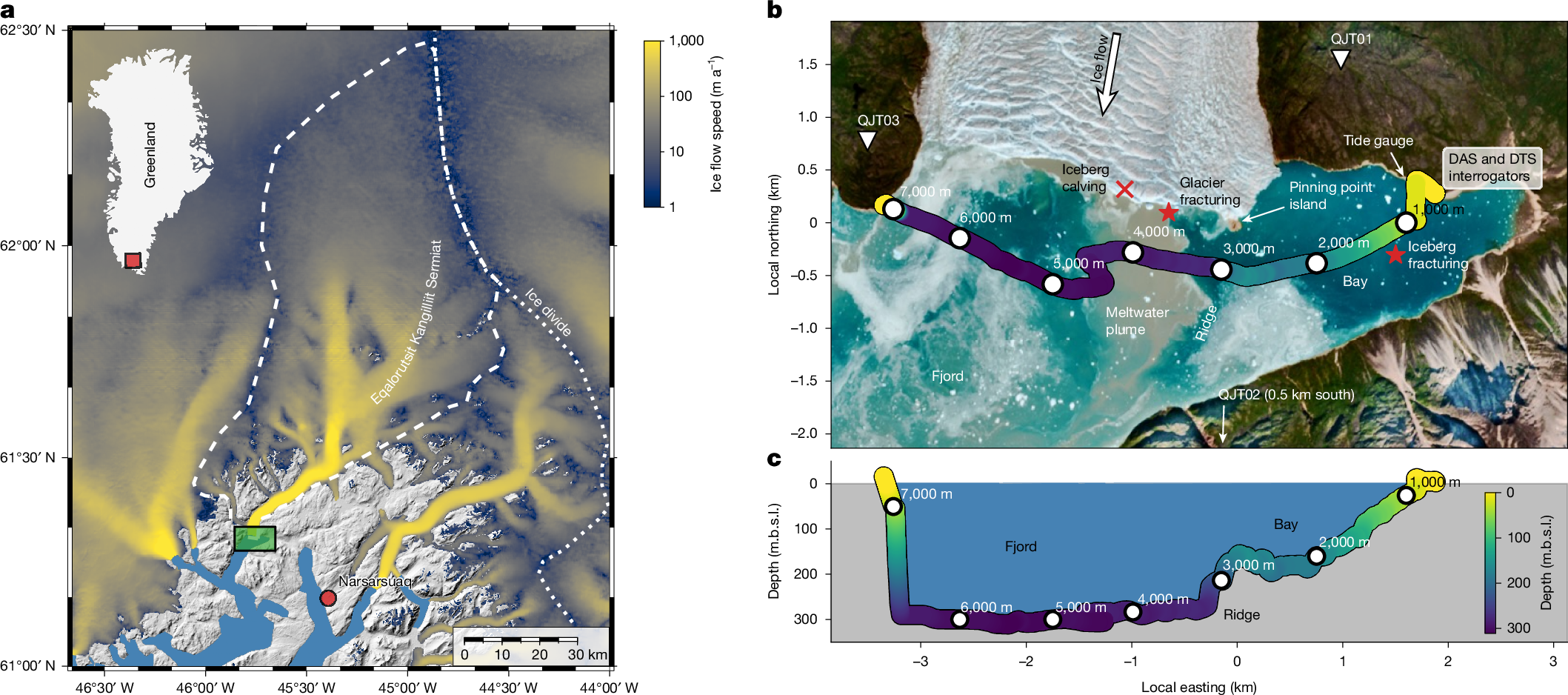
Interactions between melting ice and a warming ocean drive the present-day retreat of tidewater glaciers of Greenland1,2,3, with consequences for both sea level rise4 and the global climate system5. Controlling glacier frontal ablation, these ice–ocean interactions involve chains of small-scale processes that link glacier calving—the detachment of icebergs6—and submarine melt to the broader fjord dynamics7,8. However, understanding these processes remains limited, in large part due to the challenge of making targeted observations in hazardous environments near calving fronts with sufficient temporal and spatial resolution9. Here we show that iceberg calving can act as a submarine melt amplifier through excitation of transient internal waves. Our observations are based on front-proximal submarine fibre sensing of the iceberg calving process chain. In this chain, calving initiates with persistent ice fracturing that coalesces into iceberg detachment, which in turn excites local tsunamis, internal gravity waves and transient currents at the ice front before the icebergs eventually decay into fragments. Our observations show previously unknown pathways in which tidewater glaciers interact with a warming ocean and help close the ice front ablation budget, which current models struggle to do10. These insights provide new process-scale understanding pertinent to retreating tidewater glaciers around the globe.