
2025-08-06 イリノイ大学アーバナ・シャンペーン校
イリノイ大学の研究チームは、人工営巣箱(バットボックス)内の過熱によるコウモリの死亡リスクを軽減する簡易な設計変更を提案。断熱材と水層を用いた構造により、日中の高温化を防ぎ夜間の冷却も抑制できることを実験で示した。さらに、塗装の色や箱の向きを調整することで、地域ごとに適切な温度管理が可能になる。設計支援用のオープンソースツールも公開されており、コウモリ保全への貢献が期待されている。
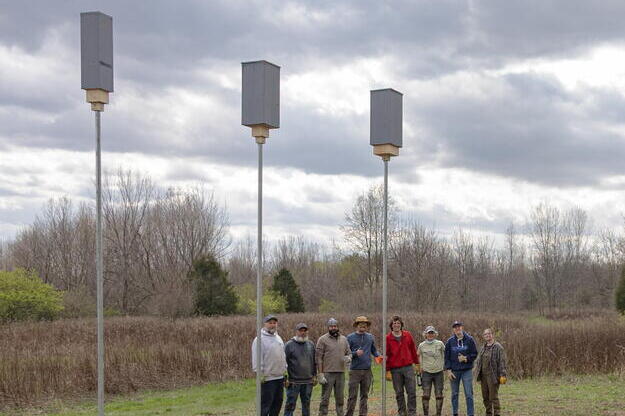
Joy O’Keefe (third from right) and the research team pose next to bat boxes.
<関連情報>
- https://aces.illinois.edu/news/simple-design-changes-can-make-bat-boxes-safer
- https://besjournals.onlinelibrary.wiley.com/doi/10.1002/2688-8319.70057
単純な設計変更で、異なる生息地におけるコウモリの箱の熱条件を生活史要件に合わせる Simple design modifications can tailor bat box thermal conditions to life history requirements in different habitats
George S. Bakken, Joy M. O’Keefe
Ecological Solutions and Evidence Published: 09 June 2025
DOI:https://doi.org/10.1002/2688-8319.70057

Abstract
- Artificial roosts (e.g. bat boxes) are widely used as surrogates for the large dead or damaged trees typically preferred by maternal female bats for pup rearing, but are also used by other life stages. Although roost temperature plays a critical role in promoting energy savings and increasing growth rates for pups, we lack rigorous data on how simple structural modifications and placement choices affect artificial roost temperatures.
- To obtain structural data, we tested modifications of the commonly used rocket box design with a simplified heat transfer analysis. Modifications varied box insulation, heat storage, colour, dimensions and orientations. We illustrate the results with plots of bat chamber temperatures for 3 consecutive days with representative weather combinations.
- Incorporating a layer of insulation above a heat storage layer stabilizes bat box internal temperatures. A water-filled layer provides compact heat storage and locks internal temperature to ≥0°C until the water is frozen. In a sunny environment, the choice of box colour and orientation can reduce temperature extremes and stabilize temperatures (e.g. at low latitudes a flat box with an E-W long axis and white south and west sides provided stable temperatures <40°C while other orientations did not).
- Box designs can also allow bats to select preferred temperatures, for example, by placing bat chambers both outside and inside an insulating or heat storage layer or increasing vertical temperature gradients with a taller box.
- Practical Implication. Our results and similar modelling will reduce effort by focusing field experiments on designs that are likely to satisfy bats’ physiological requirements during key life history stages in varying habitats and possible future (warmer) climates.


