2025-08-01 国土地理院
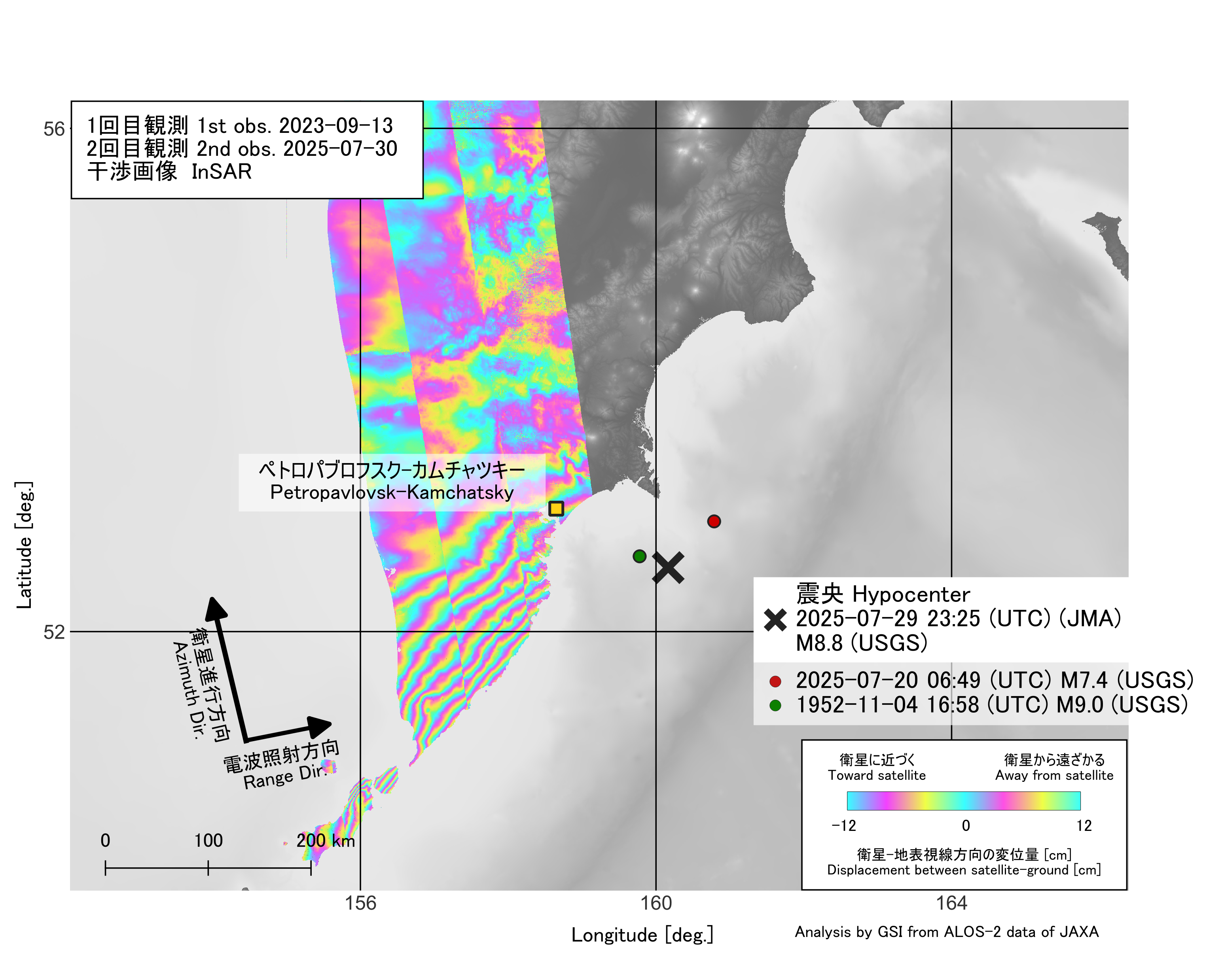
2025年7月30日8時25分(JST)(2025年7月29日23時25分(UTC))頃にカムチャツカ半島付近でM8.8(米国地質調査所:USGS)の地震が発生しました。JAXAの地球観測衛星「だいち2号」(ALOS-2)に搭載された合成開口レーダー(PALSAR-2)のデータを使用して画像の解析を行いました。
・カムチャツカ半島南部で、最大1m程度の衛星から遠ざかる変動が見られます。

<関連情報>
- https://www.gsi.go.jp/cais/topic20250730_Kamchatsky.html
- https://earthquake.usgs.gov/earthquakes/eventpage/us6000qw60/executive
M 8.8 – 2025年 ロシア カムチャッカ半島地震 M 8.8 – 2025 Kamchatka Peninsula, Russia Earthquake
Earthquake Hazards Program
In cooperation with USGS
https://earthquake.usgs.gov/data/comcat/contributor/us/
Tectonic Summary
The July 29, 2025, M8.8 earthquake east of Petropavlovsk-Kamchatsky, Russia, occurred as the result of shallow reverse faulting. At the location of this earthquake, the Pacific plate is moving west-northwest with respect to the North America plate at about 80 mm/yr. Note, the North American plate extends westward beyond the North American continent. The earthquake’s location and sense of motion is consistent with faulting on the subduction zone plate interface of the Kuril-Kamchatka arc.
While commonly plotted as points on maps, earthquakes of this size are more appropriately described as slip over a larger fault area. Reverse faulting events of the size of the July 29, 2025, earthquake are typically about 390 km by 140 km in size (length x width).
The 29 July 2025, Mw 8.8 Kamchatka earthquake is the largest event to occur globally since the 2011 Mw 9.1 Tohoku, Japan earthquake, and among the top ten largest earthquakes to occur globally since 1900. The 29 July 2025, Mw 8.8 event is the latest in a sequence of earthquakes occurring offshore of the Kamchatka peninsula that began 10 days earlier. Preceding the Mw 8.8 earthquake were 50 Mw 5.0+ earthquakes, including an Mw 7.4 earthquake on 20 July 2025, and three Mw 6.6 earthquakes. As of 4:00 AM UTC, 30 July 2025, there have been 24 aftershocks greater than Mw 5.0, including Mw 6.9 and 6.3 events.
These earthquakes occurred in the seismically active Kuril-Kamchatka subduction zone, where the Pacific plate subducts northwest beneath the North America plate. The surface expression on this subduction zone (Kuril-Kamchatka trench) lies to the east of the Kuril Islands and Kamchatka peninsula. In this region, the Pacific plate moves northwestward at a rate of ~80 mm/yr, making it one of the fastest convergent margins in the world. This region offshore of the Kamchatka peninsula has had nearly 700 Mw 5.0+ earthquakes since 1990 (not including the 29 July 2025, event and its aftershocks). The northern section of this subduction zone has previously hosted two very large earthquakes over the past ~100 years. In 1923, an Mw 8.4 earthquake, assumed to have ruptured the subduction zone interface, occurred 150 km north of the 29 July 2025, epicenter. The largest recorded earthquake in the Kamchatka section of the subduction zone was an Mw 9.0 earthquake in 1952. The 1952 epicenter is less than 30 km from the 29 July 2025, epicenter, and the 1952 earthquake ruptured 600 km of the subduction zone interface to the southwest (Johnson and Satake, 1991). At 80 mm/yr, this region has accommodated approximately 6 meters of plate motion since 1952. The 29 July 2025, Mw 8.8 earthquake appears to have generally filled any small gap between the 1923 and 1952 ruptures, although subsequent analyses will provide more information about the mainshock rupture process and the spatial relationships between these large earthquake ruptures in the region.