
2025-07-31 バッファロー大学 (UB)
<関連情報>
- https://www.buffalo.edu/news/releases/2025/07/liu-e-textile.html
- https://www.nature.com/articles/s41467-025-61843-6
滑り駆動型バイオニック触覚センシングシステム:動的DC発電機を統合したE-テキスタイルを用いた器用なロボット操作 Slip-actuated bionic tactile sensing system with dynamic DC generator integrated E-textile for dexterous robotic manipulation
Vashin Gautham,Ashutosh Panpalia,Hamid Manouchehri,Krushang Khimjibhai Gabani,Vinoop Anil,Shakunthala Yerneni,Rohit Thakar,Aayush Nayyar,Mandar Anil Payare,Emily Jorgensen,Ruizhe Yang,Ehsan Esfahani & Jun Liu
Nature Communications Published:30 July 2025
DOI:https://doi.org/10.1038/s41467-025-61843-6
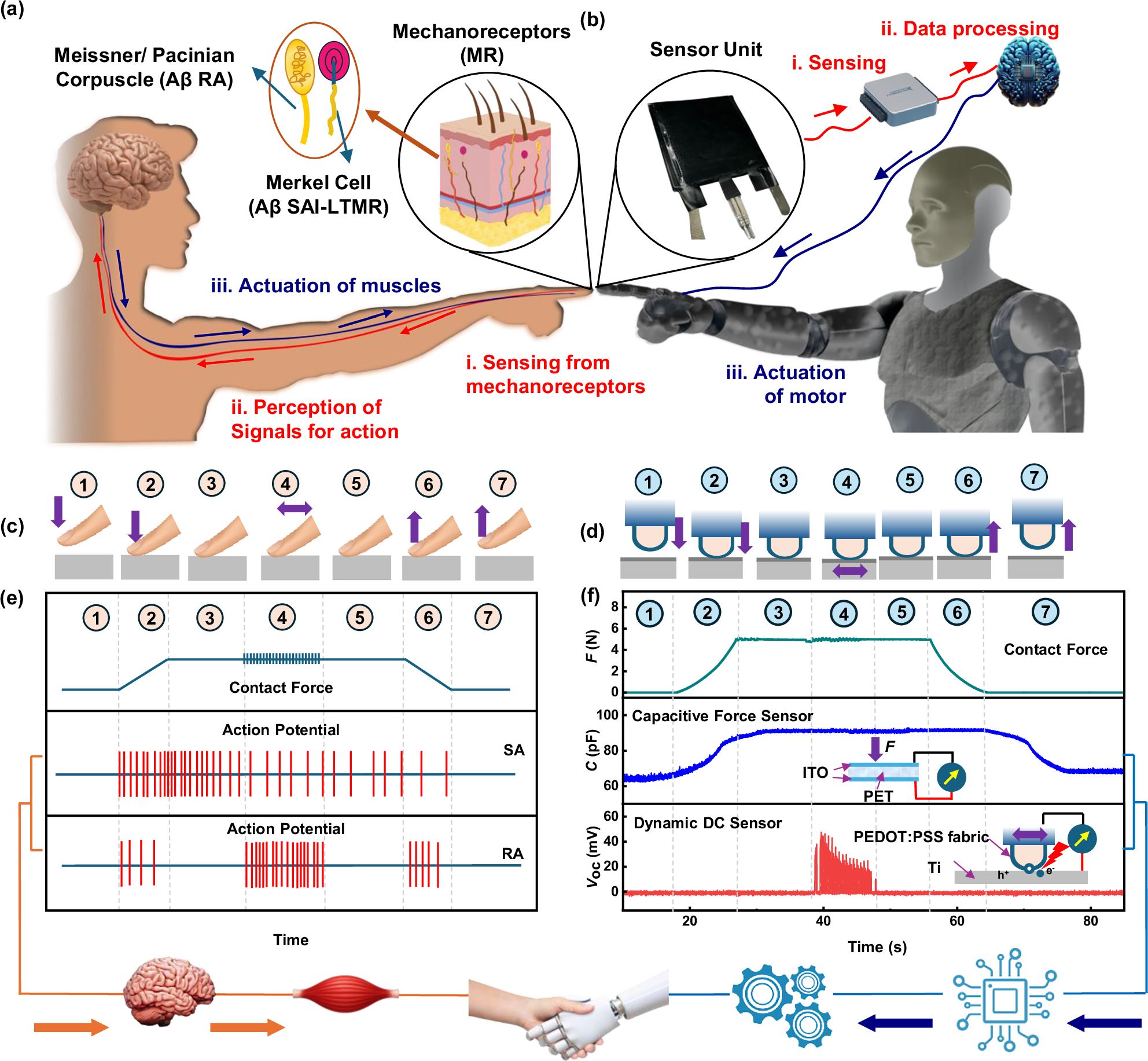
Abstract
Dexterous manipulation in robotics requires coordinated sensing, signal processing, and actuation for real-time, precise object control. Despite advances, the current artificial tactile sensory system lacks the proficiency of the human sensory system in detecting multidirectional forces and multimodal stimuli. To address this limitation, we present a bio-inspired “slip-actuated” tactile sensing system, incorporating dynamic direct-current generator into stretchable electronic textile. This self-powered bionic tactile sensing system operates in conjunction with a normal force sensor, paralleling the functions of human rapid-adapting and slow-adapting mechanoreceptors, respectively. Furthermore, we tailor and integrate the bionic tactile sensing system with robotic fingers, creating a bionic design that mimics human skin and skeleton with mechanoreceptors. By embedding this system into the feedback loop of robotic fingers, we are able to achieve fast slip and grasp monitoring, as well as effective object manipulation. Moreover, we perform quantitative analysis based on Hertzian contact mechanics to fundamentally understand the dependency of output on force and velocity in our sensor system. The results of this work provide an artificial tactile sensing mechanism for AI-driven smart robotics with human-inspired tactile sensing capabilities for future manufacturing, healthcare, and human-machine interaction.


