2025-05-06 アメリカ合衆国・ロチェスター大学
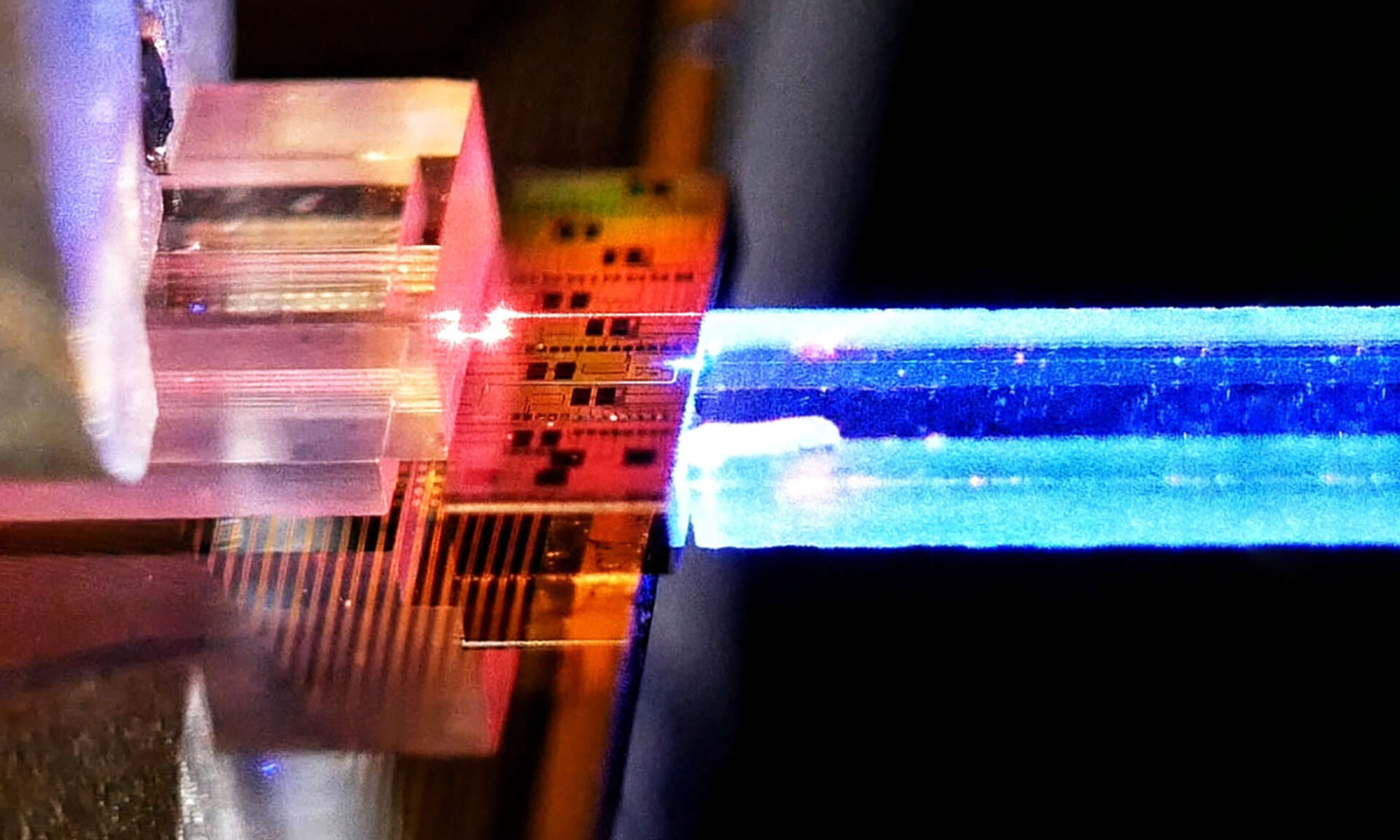 NETWORK IT: A photonic chip coupled to a highly nonlinear crystal and a fiber array unit. The crystal produces entangled visible-telecom photon pairs, which are processed on silicon nitride and silicon photonic integrated circuits enabling a compact and versatile platform to link visibly accessed quantum nodes over existing telecommunications infrastructure. (Photo courtesy of RIT)
<関連情報>
- https://www.rochester.edu/newscenter/experimental-communications-rochester-quantum-network-roqnet-651182/
- https://opg.optica.org/opticaq/fulltext.cfm?uri=opticaq-3-2-211&id=570445
ハイブリッドPPKTP–PICプラットフォーム上の可視光–テレコムペア光源からの予兆付きテレコム単一光子 Heralded telecom single photons from a visible–telecom pair source on a hybrid PPKTP–PIC platform
Vijay S. S. Sundaram, Evan Manfreda-Schulz, Todd Hawthorne, Tony Roberts, Thomas Palone, Venkatesh Deenadayalan, Mario Ciminelli, Phil Battle, Gerald Leake, Daniel Coleman, Michael L. Fanto, Nick Vamivakas, Gregory A. Howland, and Stefan F. Preble
Optica Quantum Published: April 22, 2025
DOI:https://doi.org/10.1364/OPTICAQ.546774
Abstract
We present a heralded photon-pair source using periodically poled potassium titanyl phosphate (PPKTP) waveguides coupled with photonic integrated circuits (PICs). The PPKTP generates correlated visible–telecom photon pairs, processed by the dual-band silicon and silicon nitride PIC. Heralding at visible wavelengths removes the need for large superconducting nanowire single-photon detectors (SNSPDs). Silicon Mach–Zehnder interferometers (MZIs) on the PIC modulate the telecom single photons and also serve as pump-rejection filters. We demonstrate an insertion loss of 2.37 ± 1.03 dB (4.46 ± 1.32 dB) at the visible (telecom) wavelength between the PPKTP waveguides and PIC edge couplers, and an on-chip pump suppression of 92.5 ± 2.5 dB. This platform will enable remote quantum nodes to securely communicate over telecom fiber-optic networks.