2025-07-21 ジョージア工科大学(Georgia Tech)
<関連情報>
- https://research.gatech.edu/electron-beam-technique-carves-and-constructs-nanoscale
- https://advanced.onlinelibrary.wiley.com/doi/10.1002/adfm.202514610
電子線誘導金属酸化物還元によるピーク・イン・バレー金属ナノ構造 Peak-in-Valley Metal Nano-Architectures via E-Beam-Guided Metal Oxide Redox
Auwais Ahmed, Andrei G. Fedorov
Advanced Functional Materials Published: 14 July 2025
DOI:https://doi.org/10.1002/adfm.202514610
Abstract
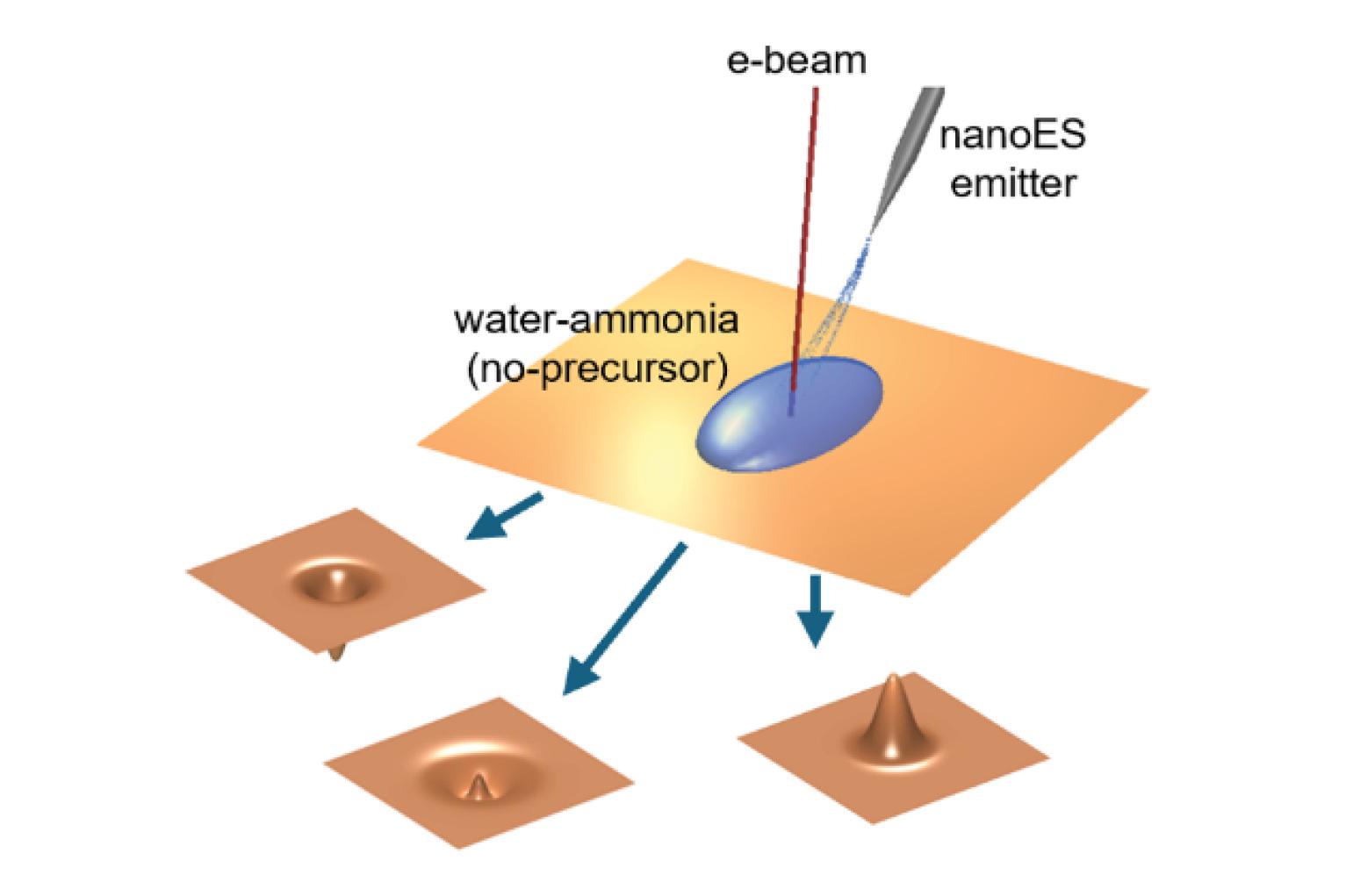
Focused electron beams enable nanoscale material modification via localized etching or deposition. In liquid-phase electron-beam-mediated processing, radiolysis-driven redox reactions present an opportunity to control both etching and deposition simultaneously. Here, this duality using a water-ammonia solvent as a tunable redox mediator on copper surfaces is demonstrated. At lower ammonia concentrations, the oxidation process dominates, etching copper to sub-50-nm depths. The copper ions and ion-complexes released during this initial oxidation step are reduced by solvated electrons resulting in metal deposition into the etched sites, over longer e-beam exposures, producing characteristic peak-in-valley nanostructures. Conversely, at higher ammonia concentrations copper-ammine ion complexation and radiolytic oxidizing species scavenging by ammonia occur at higher rates, creating a reducing environment conducive to rapid beam-guided copper deposition. Reaction-transport simulations and experiments are performed to show the effects of ammonia-mediated radiolysis chemistry, describing the direct influence of solvent concentration on redox balance and the outcome of e-beam guided processing. By uniting both etching and deposition within a single framework, this work provides a versatile route for controlled surface nanostructuring.