2025-07-24 中国科学院(CAS)
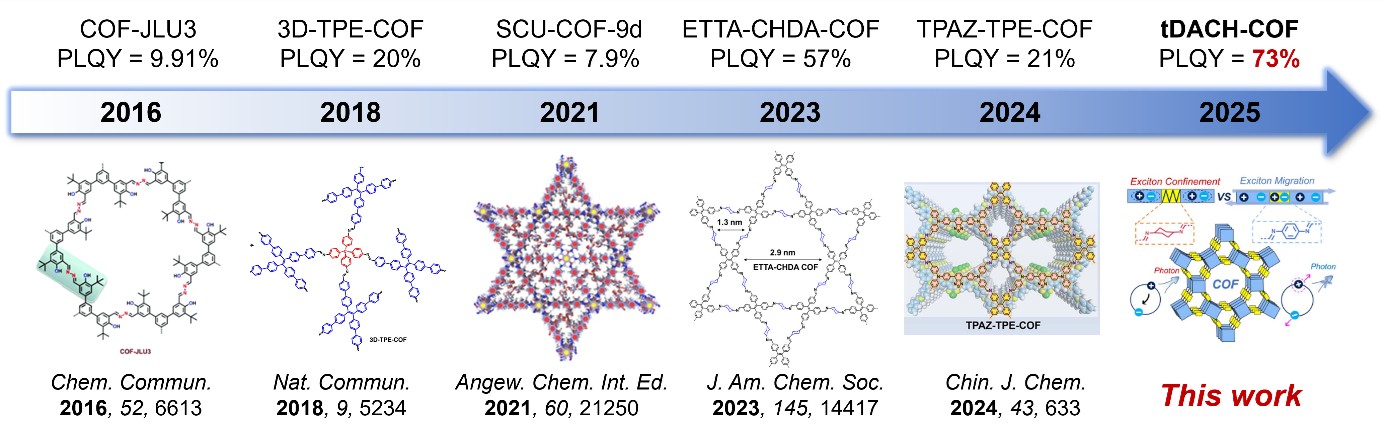
Timeline of imine-based COFs and their corresponding photoluminescent performance. (Image by Prof. DOU’s group)
<関連情報>
- https://english.cas.cn/newsroom/research_news/chem/202507/t20250721_1047696.shtml
- https://www.cell.com/cell-reports-physical-science/fulltext/S2666-3864(25)00320-0
共有結合性有機フレームワークにおける量子閉じ込め効果の実現により高光励起発光を実現 Achieving quantum confinement effect in covalent organic frameworks for high photoluminescence
Longlong Liang ∙ Jiawen Li ∙ Jinliang Ning ∙ Yihang Wang ∙ Baiyi Zu ∙ Xincun Dou
Cell Reports Physical Science Published:July 23, 2025
DOI:https://doi.org/10.1016/j.xcrp.2025.102721
Highlights
- Conjugation degree modulation strategy was utilized to synthesize a series of COFs
- Quantum confinement effect was realized in tDACH-COF with cyclohexane linker
- Photoluminescent performance of tDACH-COF surpasses all reported imine-based COFs
- The tDACH-COF enables PL quenching detection of ppb-level nerve agent simulant
Summary
Although the quantum confinement effect has been achieved through physical size reduction, it has never been realized via exciton radius modulation without physical downsizing. Here, by introducing “breakpoints” of conjugation into the covalent organic frameworks (COFs), it is found that the engineered π-conjugated domains could enable the intrinsic exciton confinement at the molecular level, bypassing the need for physical downsizing unprecedentedly. This strategy remarkably bears the quantum confinement effect in the trans-1,4-diaminocyclohexane (tDACH)-COF, enabling a photoluminescence quantum yield (PLQY) of 73%, making it incomparable to all existing COFs. Furthermore, we demonstrated that the protonation in the tDACH-COF could expand the exciton radius within the framework using transient spectroscopy. Consequently, the tDACH-COF exploited in this work exhibited exceptional nerve agent sensing performance with an extremely low detection limit of 4.6 ppb and superior selectivity. This work represents a revolutionary breakthrough in both quantum physics and crystalline organic porous materials and will redefine quantum engineering principles.