2025-07-15 東京理科大学
ChatGPT:
<関連情報>
- https://www.tus.ac.jp/today/archive/20250715_8098.html
- https://www.nature.com/articles/s41598-025-00357-z
特徴拡張されたギンツブルグ・ランダウ自由エネルギーフレームワークによる非方向性電磁鋼板のエネルギー損失起源の自動識別 Automated identification of the origin of energy loss in nonoriented electrical steel by feature extended Ginzburg–Landau free energy framework
Michiki Taniwaki,Ryunosuke Nagaoka,Ken Masuzawa,Shunsuke Sato,Alexandre Lira Foggiatto,Chiharu Mitsumata,Takahiro Yamazaki,Ippei Obayashi,Yasuaki Hiraoka,Yasuhiko Igarashi,Yuta Mizutori,Sepehri Amin Hossein,Tadakatsu Ohkubo,Hisashi Mogi & Masato Kotsugi
Scientific Reports Published:15 July 2025
DOI:https://doi.org/10.1038/s41598-025-00357-z
Abstract
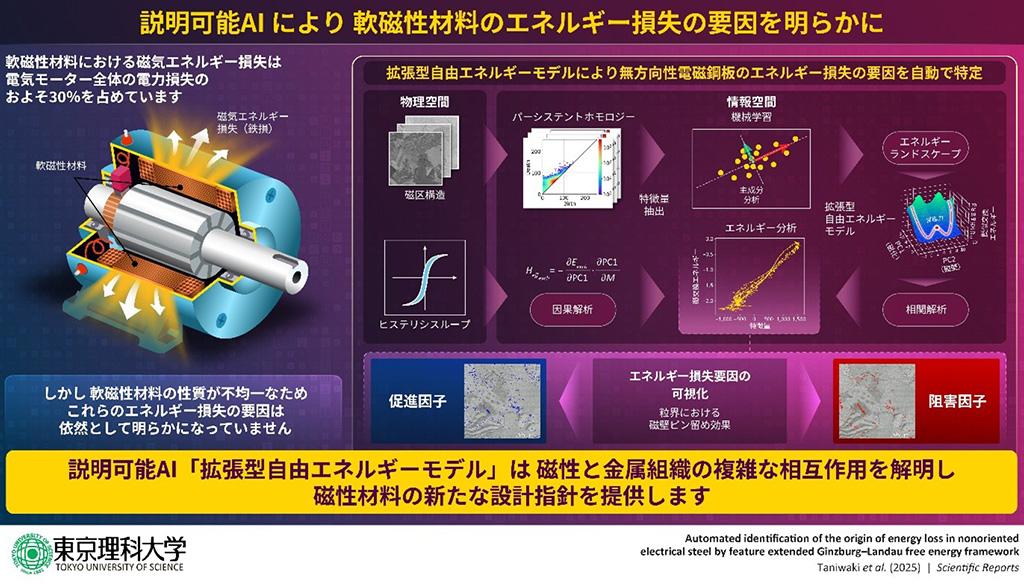
This study presents the automated identification of the complex magnetization reversal process in nonoriented electrical steel (NOES) using the feature extended Ginzburg–Landau (eX-GL) free energy framework. eX-GL provides a robust connection between microscopic magnetic domains and macroscopic magnetic hysteresis using a data science perspective. This method employs physically meaningful features to analyze the energy landscape, providing insights into the mechanisms behind function. We obtained features representing both the microstructure and energy of the domain wall. The causes of iron loss were traced to the original domain structure, through which we could successfully distinguish and visualize the role of pinning as a promoting and resisting factor. We found that the reversal process was governed not only by general grain boundary pinning but also by segmented magnetic domains within the grain. This method revealed the complex interplay between magnetism and metallography and introduced a new means for transformative material design, bridging structures and functions.