2026-11-09 中国科学院(CAS)
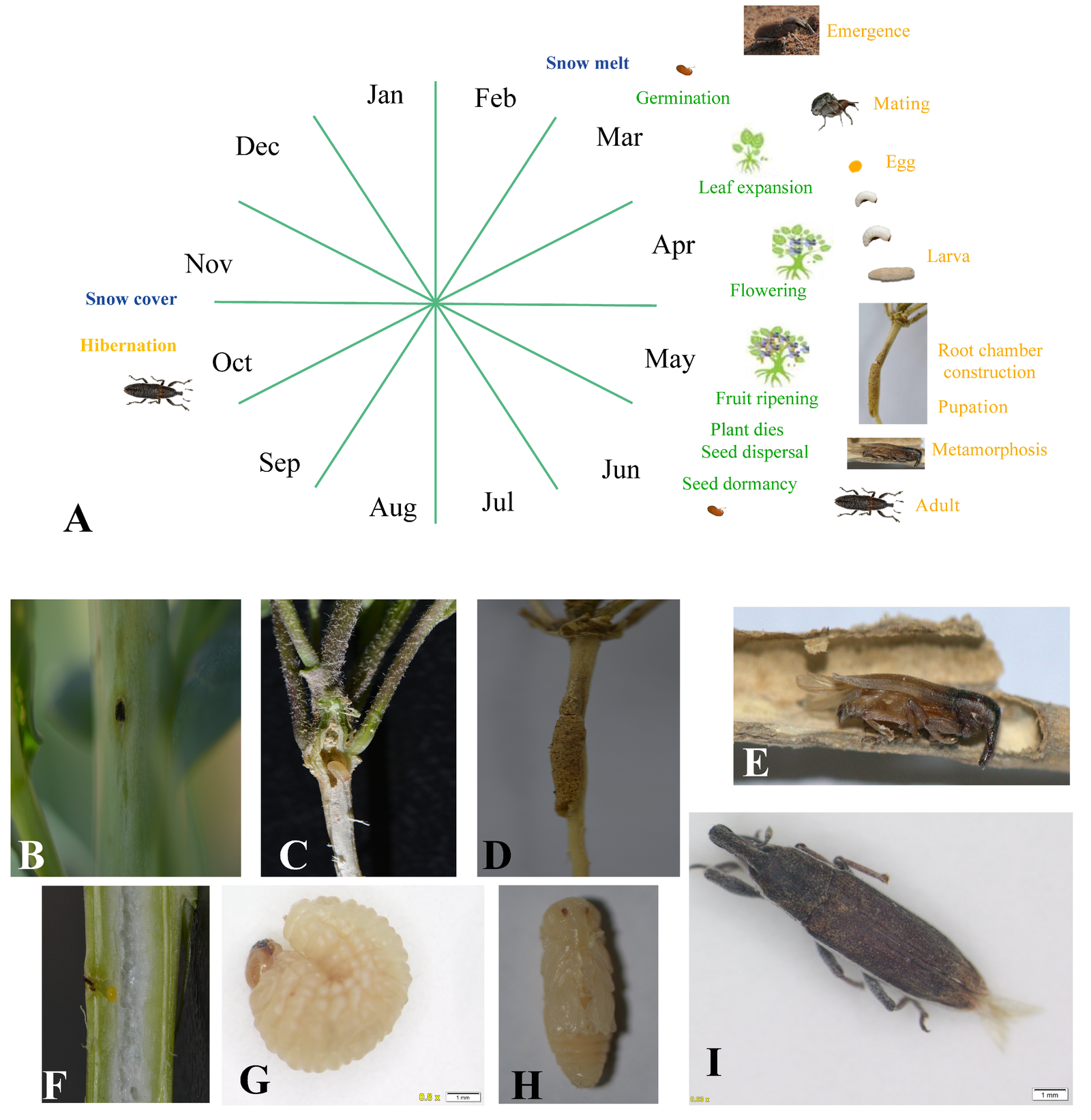
Phenological synchrony between Strigosella scorpioides and the stem-boring weevil Lixus ochraceus, and the development of the weevil inside the host plant. (Image by XIEG)
<関連情報>
- https://english.cas.cn/newsroom/research-news/202611/t20261109_1213560.shtml
- https://onlinelibrary.wiley.com/doi/10.1111/pce.70909
茎穿孔性ゾウムシLixus ochraceusと砂漠に一時的に生息するStrigosella scorpioidesの間に潜在的に促進的な相互作用が存在することを示す証拠 Evidence for a Potentially Facilitative Interaction Between the Stem-Boring Weevil Lixus ochraceus and the Desert Ephemeral Strigosella scorpioides
Lan Zhang, Huiliang Liu, Xiaohu Wen, Lingwei Zhang, Yanfeng Chen, Carol C. Baskin, Jerry M. Baskin, Yuanming Zhang
Plant, Cell & Environment Published: 07 October 2026
DOI:https://doi.org/10.1111/pce.70909
Abstract
Plant–herbivore interactions are typically antagonistic, but abiotic stress and compressed life cycles can alter both their intensity and net outcome. Herbivory is generally expected to reduce plant fitness, yet how desert ephemerals respond to low-intensity stem boring remains poorly resolved. We characterised the natural association between the desert ephemeral Strigosella scorpioides and its specialist stem-boring weevil Lixus ochraceus in the Gurbantunggut Desert, northwestern China, combining phenotypic monitoring, tissue nutrient and secondary-metabolite analyses, volatile profiling, behavioural assays and germination trials. Infestation intensity was uniformly low, with each host plant harbouring a single larva. Relative to non-host neighbours, host plants were taller, produced more branches and developed greater leaf area, and attained 2.2-fold greater peak biomass and 2.1-fold greater fruit production, consistent with overcompensation. Host plants contained lower concentrations of three glucosinolates and emitted distinct volatile blends, with a lower proportion of benzyl isothiocyanate and a higher proportion of benzaldehyde; in behavioural assays, females responded to both compounds in a concentration-dependent manner. Seeds from host plants germinated at higher rates under simulated spring snowmelt temperature regimes, although this advantage was temperature-dependent. Together, these results suggest that low-intensity stem boring can coincide with enhanced plant performance and fitness in a highly compressed growing season, and point to plant chemical traits as candidate mediators of plant–herbivore interactions in arid ecosystems. These findings challenge the prevailing assumption that herbivory is invariably antagonistic, suggesting that the sign of such interactions may be more labile than commonly recognised where brief resource windows and close phenological synchrony align.