2026-09-06 中国科学院(CAS)
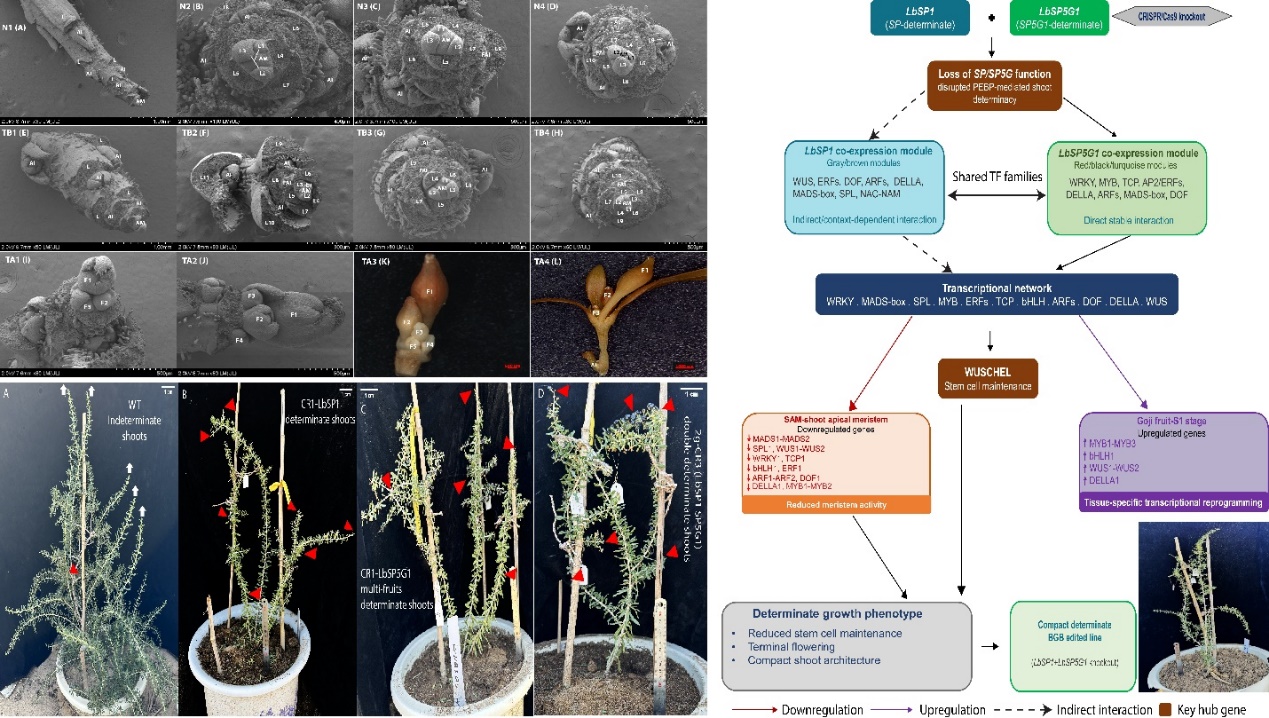
Scanning electron microscopy observations of indeterminate and determinate shoot apices, and the effects of CRISPR/Cas9-mediated knockout of LbSP1 and LbSP5G1 on shoot apical meristem development and shoot architecture reprogramming in goji berry, reveal the central PEBP regulatory network underlying determinacy and high yield. (Image by LIU Huanfang)
<関連情報>
- https://english.cas.cn/newsroom/research-news/202609/t20260907_1192719.shtml
- https://onlinelibrary.wiley.com/doi/10.1111/pbi.70753
CRISPR/Cas9を用いたLbSP1およびLbSP5G1のノックアウトにより、黒クコの実のシュート構造の効率的なカスタマイズが明らかになった CRISPR/Cas9-Mediated Knockout of LbSP1 and LbSP5G1 Reveals Efficient Customization of Shoot Architecture in Black Goji Berry
Fazal Rehman, Huanfang Liu, Yun Ma, Shaohua Zeng, Yan Wu, Yuan Zong, Chao Yang, Ying Wang
Plant Biotechnology Journal Published: 02 September 2026
DOI:https://doi.org/10.1111/pbi.70753
ABSTRACT
Goji is recognized as a nutritionally rich superfruit with medicinal and industrial importance. However, its inherently indeterminate growth habit causes asynchronous flowering and uneven fruit ripening, resulting in harvesting inefficiency with high labour costs and low fruit yield. To elucidate the molecular basis of shoot determinacy and early flowering, comparative transcriptome analysis of indeterminate and determinate shoot apices in an F1 hybrid population of Lycium barbarum identified 15 candidate genes associated with shoot growth termination and early flowering, including an SP-like gene (LbSP1, Lba0102749) and a goji homologue of SlSP5G (LbSP5G1, Lba0501086) from the phosphatidylethanolamine-binding protein (PEBP) family. CRISPR/Cas9-mediated knockout of LbSP1 and LbSP5G1 in black goji berry produced homozygous single (CRLbSP1, CRLbSP5G1) and double determinate (2gCR LbSP1 + LbSP5G1) lines exhibiting compact shoot architecture, reduced day-length sensitivity, terminal flowering, and improved fruit yield. The double determinate line showed a significantly reduced number of leaves to the first inflorescence (7.25) compared to wild-type (WT) (18.6), with fruit yield per plant of 174.94 g, followed by CRLbSP5G1 (64.55 g), CRLbSP1 (55.17 g), and WT (22.09 g). Transcriptomic and co-expression analysis revealed extensive reprogramming of flowering regulatory networks, with LbSP1 and LbSP5G1 functioning as central regulatory hubs. Protein–protein interaction assays further established functional divergence between the two genes within a PEBP-centred network governing meristem fate. These findings provide the first functional characterization of terminal flowering genes in goji, establishing a molecular framework for breeding compact, early-flowering, and high-yield cultivars optimized for mechanized harvesting.