2026-08-28 東京大学,広島大学
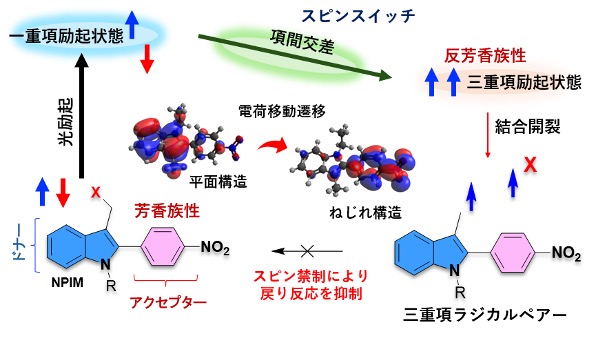
本研究で解明したNPIM分子の光励起後の解離反応機構の模式図
<関連情報>
- https://www.issp.u-tokyo.ac.jp/maincontents/news2.html?pid=32005
- https://pubs.acs.org/jacsat/article/doi/10.1021/jacs.6c13942/5386261/Mechanistic-Insights-into-Photo-Induced-Bond
2-(4-ニトロフェニル)-1H-インドール-3-イルメチル(NPIM)誘導体の光誘起結合解離のメカニズム的考察:量子スピン操作による脱ケージングの事例研究 Mechanistic Insights into Photo-Induced Bond Dissociation of a 2-(4-Nitrophenyl)-1H-indole-3-ylmethyl (NPIM) Derivative: A Case Study on Quantum Spin-Manipulation for Uncaging
Kenta Kuroishi;Ryuei Hayashi;Ryoko Oyama;Shunsuke Tanaka;Kotaro Ogawa;Yuta Murotani;Ryusuke Matsunaga;Jun Yoshinobu;Manabu Abe
Journal of the American Chemical Society Published:August 31, 2026
DOI:https://doi.org/10.1021/jacs.6c13942
Abstract
Photolabile protecting groups (PPGs) are indispensable tools for spatiotemporally controlled release of reactive functional groups. Recently, we proposed a quantum spin-manipulation (QSM-1) strategy that employs triplet ground-state cations to render ion-pair recombination spin-forbidden, thereby enhancing the uncaging quantum yield. In this study, the photodissociation mechanism of a 2-(4-nitrophenyl)-1H-indole-3-ylmethyl (NPIM) photocage bearing a benzoate leaving group was investigated to evaluate the effectiveness of a triplet excited-state-mediated QSM pathway (QSM-2). Spectroscopic analyses revealed that the excited state of NPIM possesses a relatively small singlet–triplet energy gap (ΔEST = 5.3 kcal mol–1), enabling efficient intersystem crossing (ISC) from the intramolecular charge-transfer singlet excited state to the triplet excited state. Oxygen-quenching experiments demonstrated that photodissociation proceeds predominantly from the triplet excited state. Time-resolved absorption spectroscopy identified the singlet excited state (τ = 1.6 ns), triplet excited state (τ = 2.3 μs), and NPIM radical intermediate (τ = 1.5 ms). In situ infrared analysis directly detected benzoic acid, an oxidized NPIM product, and CO2 generated from the benzoyl radical, supporting a homolytic bond-cleavage mechanism. Ultrafast time-resolved infrared spectroscopy of the NPIM chromophore revealed formation of a twisted intramolecular charge-transfer state that promotes ISC by reducing ΔEST. Density functional theory calculations further indicate that C–O bond homolysis from the triplet excited state is energetically feasible and is driven by relief of excited-state antiaromaticity. These results establish that uncaging of NPIM derivatives proceeds through triplet-state homolysis and demonstrate the validity of the QSM-2 strategy for designing efficient photochemical release systems.