2026-06-16 中国科学院(CAS)
<関連情報>
- https://english.cas.cn/newsroom/research-news/202606/t20260616_1169143.shtml
- https://iopscience.iop.org/article/10.3847/1538-4357/ae6454
共生電波天文学FASTサーベイで発見された、巨大白色矮星を伴う2つの連星パルサーの追跡観測Follow-up Timing of Two Binary Pulsars with Massive White Dwarfs Discovered in Commensal Radio Astronomy FAST Survey
D. Zhao, J. P. Yuan, N. Wang, D. Li, P. Wang, M. Y. Xue, W. W. Zhu, C. C. Miao, W. M. Yan, L. Li,…
The Astrophysical Journal Published: 2026 May 22
DOI:10.3847/1538-4357/ae6454
Abstract
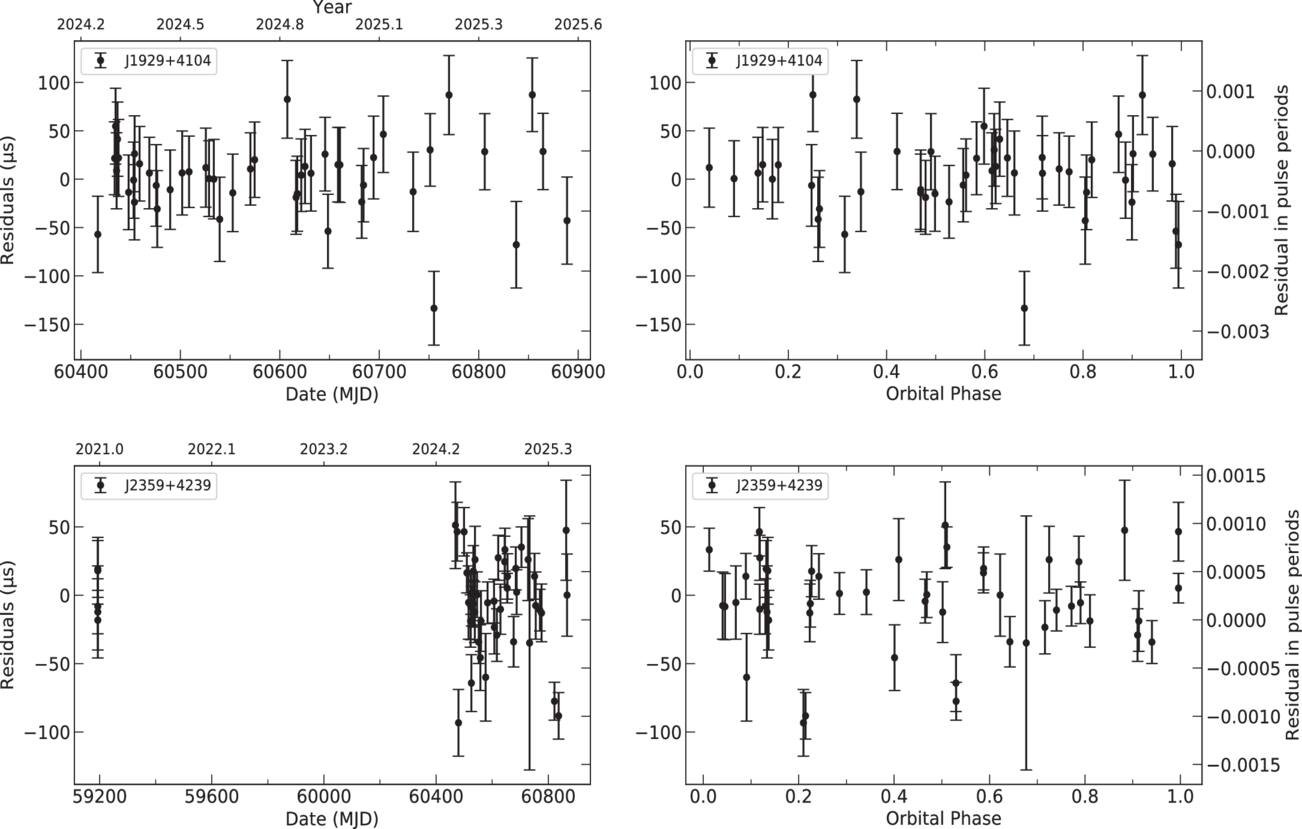
We present phase-connected timing solutions, total-intensity and polarized profiles for two newly discovered pulsars, PSRs J1929+4105 and J2359+4239, identified by the Five-hundred-meter Aperture Spherical radio Telescope (FAST) in the Commensal Radio Astronomy FAST Survey (or CRAFTS). PSR J1929+4105 has a spin period of 41.59 ms and is in a 63 days orbit with an eccentricity of 0.00042. PSR J2359+4239, with a spin period of 60.53 ms, is in a 4 days orbit with an eccentricity of 0.0003. Since no post-Keplerian parameters have been measured for either system, we can only constrain the companion masses based on the mass function. The minimum companion masses for PSRs J1929+4105 and J2359+4239 are 0.72 M⊙ and 0.467 M⊙, respectively. Given the small eccentricities of these systems, which rule out the possibility of double neutron star systems, we propose that both systems consist of a pulsar and a massive white dwarf companion. Simulations of the formation processes for these two systems were conducted using the rapid binary population synthesis code COMPAS. We estimated their distances using the NE2001 and YMW16 electron-density models, thereby contributing new data to the Galactic electron-density distribution. Motivated by the numerous discoveries of millisecond pulsar binaries by FAST, we further studied their height distribution in the Galaxy.