2026-05-28 合肥物質科学研究院(HFIPS)
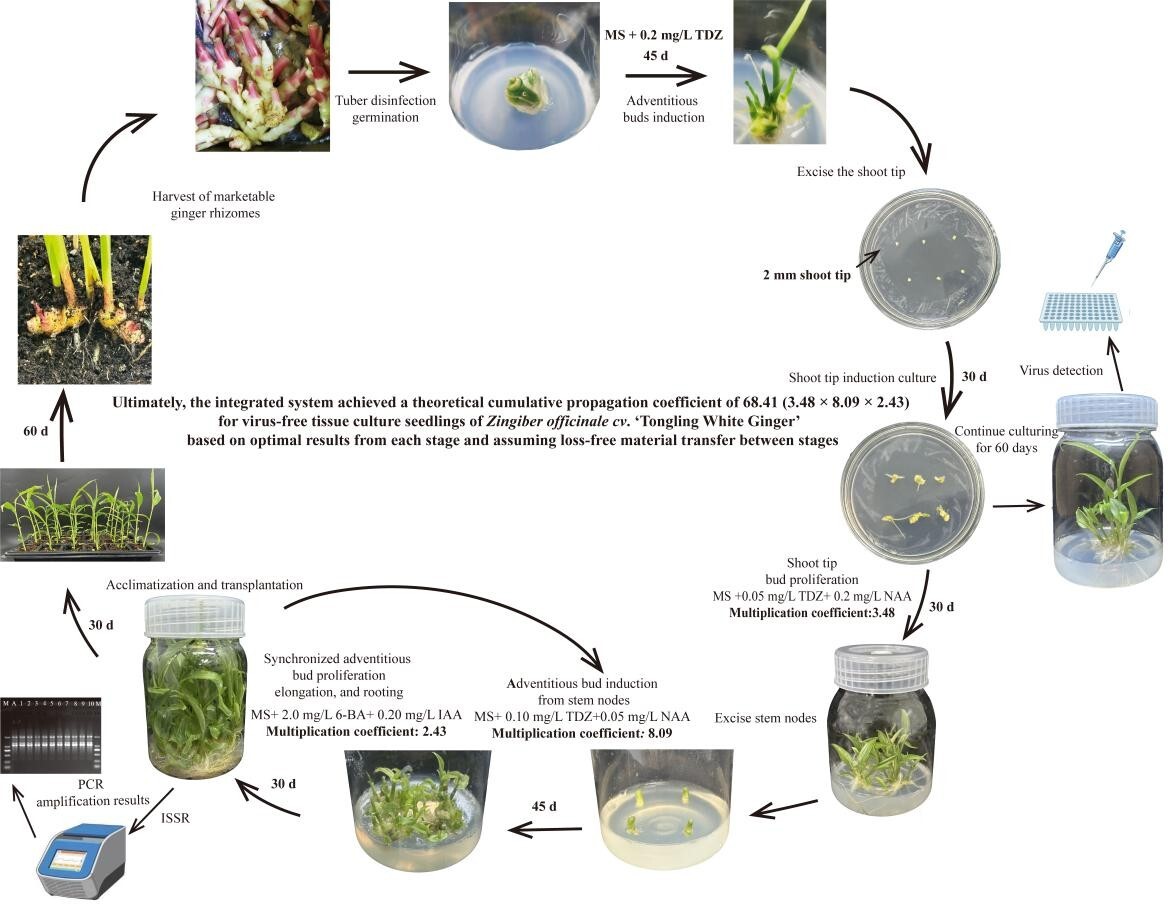
Establishment of a high-efficiency in vitro regeneration system for Tongling white ginger (Image by WANG Dacheng)
<関連情報>
- https://english.hf.cas.cn/nr/rn/202605/t20260528_1160015.html
- https://www.sciencedirect.com/science/article/pii/S0926669026005820
ウイルスフリーの銅陵白ショウガのための効率的な統合型in vitro増殖システムの開発とその遺伝的忠実性の評価 Development of an efficient integrated in vitro propagation system for virus-free Tongling white ginger and assessment of its genetic fidelity
Rongkui Liao, Dacheng Wang, Weixiang Xiao, Jing Wang, Pai Li, Jun Chen, Ning Wang, Ronghao Cai, Lifang Wu, Jinyan Hou
Industrial Crops and Products Available online: 10 April 2026
DOI:https://doi.org/10.1016/j.indcrop.2026.123195
Highlights
- Efficient virus-free regeneration of Tongling white ginger via shoot tip culture.
- Integrated system achieved theoretical cumulative propagation coefficient of 68.41.
- ISSR analysis verified no detectable genetic variation in regenerants after five subcultures.
- Synchronizing shoot proliferation, elongation and rooting reduces the process from three steps to one.
Abstract
Tongling white ginger, a national geographical indication product of China, has significant economic value in medicine, food, and culinary uses. However, germplasm degradation and the low propagation efficiency of traditional rhizome-based reproduction severely constrain its industrial development. Here, we established an integrated in vitro regeneration and virus elimination system encompassing rhizome-induced adventitious shoot formation, shoot tip culture with virus eradication, basal stem segment propagation, synchronous proliferation-elongation-rooting, transplantation, and genetic stability assessment. For rhizomes, MS medium containing 0.2 mg/L TDZ achieved an 85.55% induction rate (5.93 shoots/explant). For 2.0 mm shoot tips, MS medium fortified with 0.2 mg/L 6-BA resulted in a 44.19% regeneration rate with 100% virus elimination, while a proliferation coefficient of 3.48 was obtained on MS medium containing 0.05 mg/L TDZ and 0.2 mg/L IBA. For basal stem segments, MS medium supplemented with 0.1 mg/L TDZ and 0.05 mg/L NAA supported 100% induction, producing 8.09 shoots per explant. Synchronous culture on MS medium containing 2.0 mg/L 6-BA and 0.2 mg/L IAA yielded robust plantlets with a multiplication coefficient of 2.43 and an average of 9.17 roots per plantlet. Under optimal conditions and assuming loss-free material transfer between stages, the integrated system achieved a theoretical cumulative propagation coefficient of 68.41, with 100% transplant survival. ISSR analysis of the fifth subculture generations revealed no detectable genetic variation at the surveyed loci among the tested regenerants and the mother plant. This protocol provides a technical basis for the potential commercial production of virus-free, genetically uniform seedlings, which is essential for elite germplasm conservation and sustainable cultivation of Tongling white ginger.
](https://tiisys.com/wp-content/uploads/2026/05/スクリーンショット-2026-05-28-185448.png "特定非営利活動法人ピースウィンズ・ジャパン アエロスパシアルAS350B(回転翼航空機)の事故[墜落](広島県神石郡神石高原町、令和4年8月15日発生)")