2026-05-21 東京大学
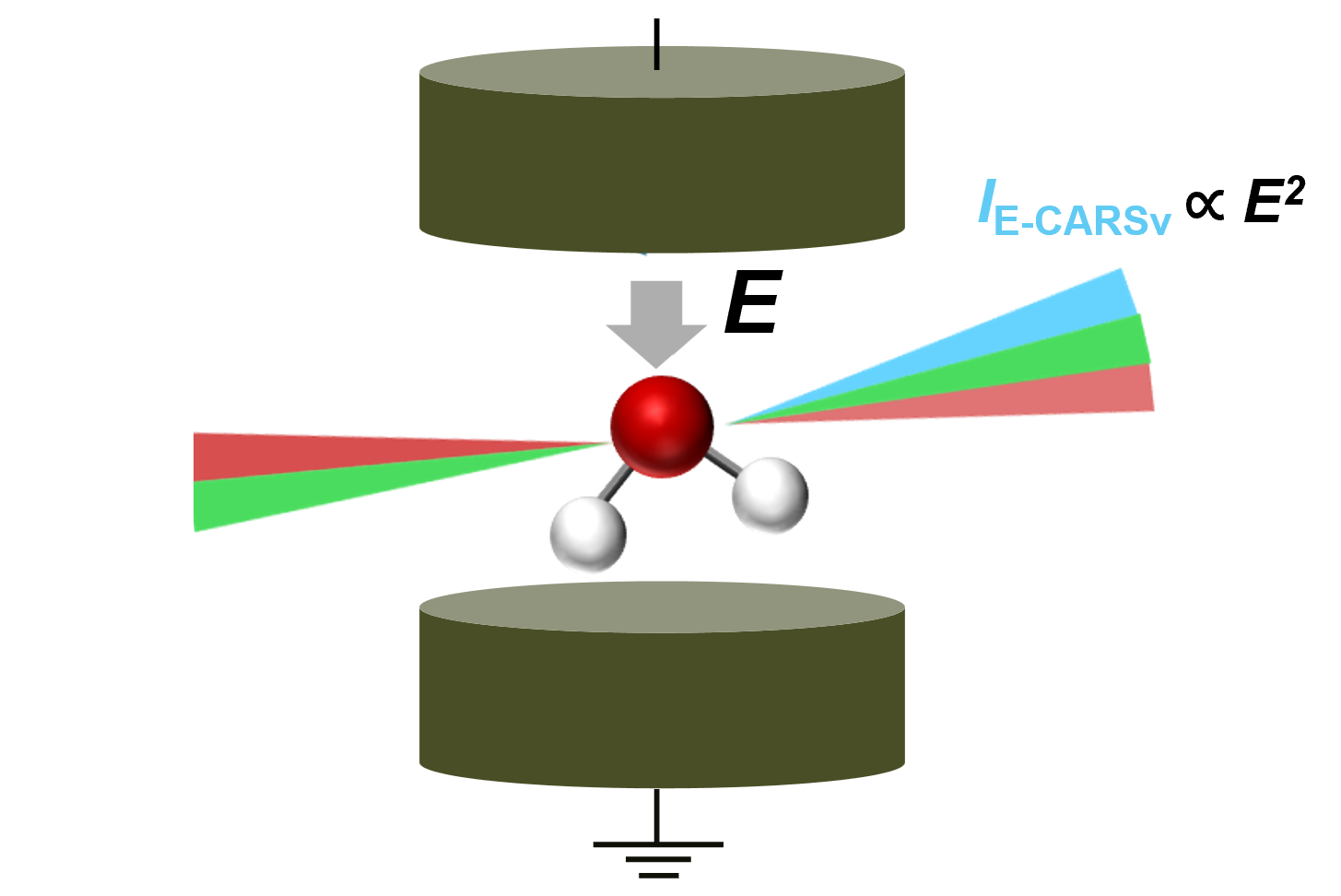
図1 水分子E-CARSvの概念図
<関連情報>
- https://www.k.u-tokyo.ac.jp/information/category/press/0029949.html
- https://pubs.aip.org/aip/apl/article-abstract/128/20/203304/3391637/Sensitive-remote-electric-field-measurements-using?redirectedFrom=fulltext
水蒸気を分子プローブとして用いた高感度遠隔電場測定
Sensitive remote electric field measurements using water vapor as a molecular probe
Lisa Kobodo;Takeru Koike;David Z. Pai;Hitoshi Muneoka;Kazuo Terashima;Tsuyohito Ito
Applied Physics Letters Published:May 19 2026
DOI:https://doi.org/10.1063/5.0325121
A number of molecular processes involving water molecules occur under the influence of electric fields and/or charges. This Letter demonstrates sensitive electric field detection as low as 5.6 V/mm via coherent anti-Stokes Raman scattering, with water molecules acting as probes. Absorption of one of the two incident laser beams by water molecules explains a decrease in the signal intensity with vapor pressure, suggesting that this method has the potential to enable electric field measurement even with an unknown density of water molecules.