2026-05-14 デラウェア大学(UD)
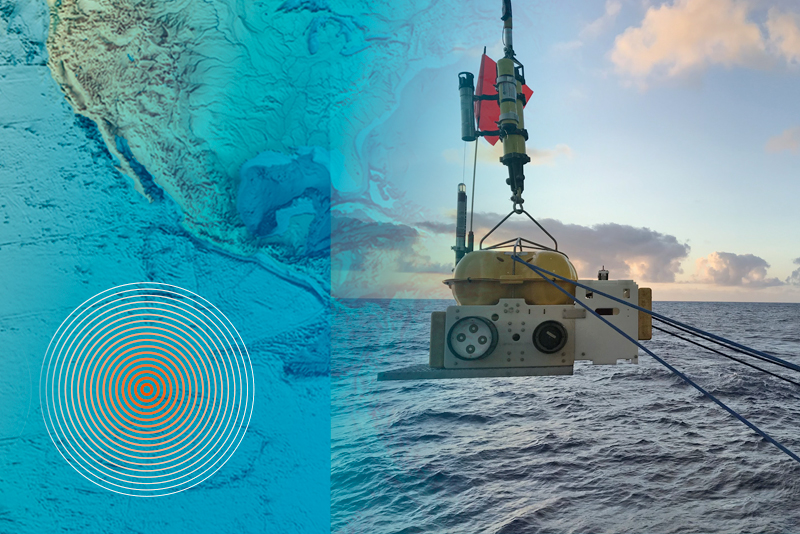
University of Delaware geologist Jessica Warren and colleagues report new understandings of how earthquakes operate on the Gofar transform fault in the Pacific Ocean.
<関連情報>
- https://www.udel.edu/udaily/2026/may/earthquake-plate-tectonics-gofar-transform-fault-study-results-science-jessica-warren-collaborators/
- https://www.science.org/doi/10.1126/science.ady6190
予測可能な地震サイクルは、海洋トランスフォーム断層上の構造的な破壊障壁によって生じる Predictable seismic cycles result from structural rupture barriers on oceanic transform faults
Jianhua Gong, Wenyuan Fan, Jeffrey J. McGuire, Mark D. Behn, […] , and Christopher R. German
Science Published:14 May 2026
DOI:https://doi.org/10.1126/science.ady6190
Editor’s summary
The Gofar transform fault cuts across the Pacific Ocean floor with a regular slip schedule, hosting a moment magnitude ~6 earthquake about every 5 years. Two deep-ocean experiments have recorded seismic activity across its earthquake cycles. Gong et al. analyzed ocean bottom seismometer data over the 2020 cycle and compared them with data from 2008. The two events occurred on segments separated by 100 kilometers. In each case, the zone adjacent to the mainshock hosted a days-long foreshock sequence and then served as a barrier to the main rupture. These observations suggest that the barrier zones help to regulate faulting through steady stress accumulation. —Angela Hessler
Abstract
Earthquakes of magnitude (M) >5.5 on oceanic transform faults (OTFs) repeatedly rupture the same locked patches, sometimes quasiperiodically. These patches are separated by “barriers” that halt earthquake propagation and slip mostly aseismically. However, the physical processes governing this systematic behavior remain unclear. We analyzed two barriers along the Gofar transform fault that have arrested ~15 M6 earthquakes over the past three decades. Ocean bottom seismometer data indicate that the barriers hosted intense microseismicity before the mainshocks and comprise multistrand faults and transtensional stepovers with 100- to 400-m lateral offset. These characteristics contradict earthquake rupture termination models invoking velocity-strengthening friction or large geometric steps and instead point to damage-enhanced porosity and dilatancy-strengthening mechanisms. By isolating rupture segments, the barriers regulate the quasiperiodic recurrence of OTF earthquakes.