2026-05-12 マサチューセッツ工科大学(MIT)
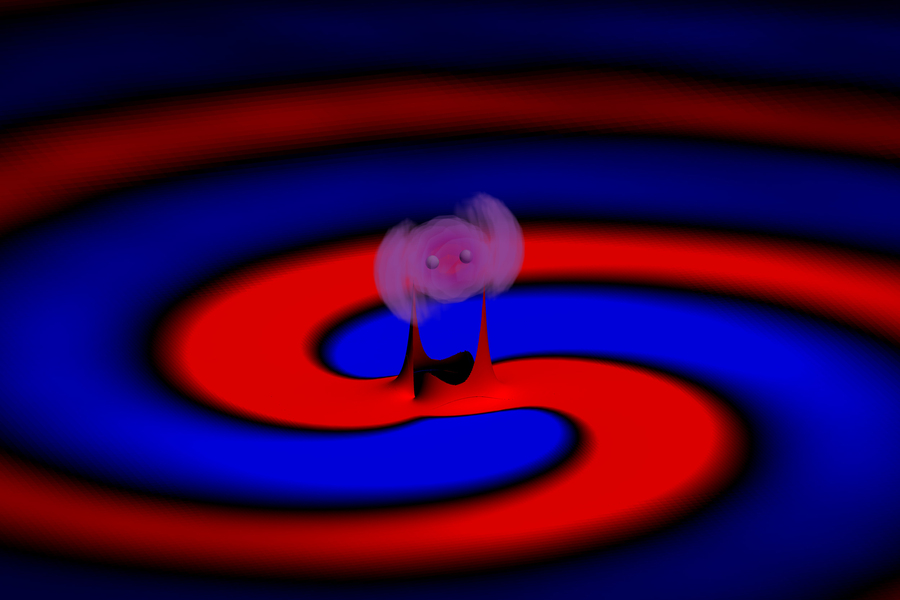
A new model developed by physicists at MIT and elsewhere predicts how gravitational waves (blue and red waves) can carry imprints of any dark matter (light purple) that two merging black holes happen to spiral through.Credit: Courtesy of the researchers
<関連情報>
- https://news.mit.edu/2026/new-way-spot-signs-dark-matter-0512
- https://journals.aps.org/prl/abstract/10.1103/fv9z-zkxx
LIGO-Virgo-KAGRAにおけるブラックホール連星系の周囲のスカラー場 Scalar Fields around Black Hole Binaries in LIGO-Virgo-KAGRA
Soumen Roy, Rodrigo Vicente, Josu C. Aurrekoetxea, Katy Clough, and Pedro G. Ferreira
Physical Review Letters Published: 12 May, 2026
DOI: https://doi.org/10.1103/fv9z-zkxx
Abstract
Light scalar particles arise naturally in many extensions of the standard model and are compelling dark-matter candidates. Gravitational interactions near black holes can trigger the growth of dense scalar configurations that, if sustained during inspiral, alter binary dynamics and imprint signatures on gravitational-wave signals. Detecting such effects would provide a novel probe of fundamental physics and dark matter. Here, we develop a semianalytic waveform model for binaries in scalar environments, validate it against numerical relativity simulations, and apply it in a Bayesian analysis of the LIGO-Virgo-KAGRA catalog. We obtain physically meaningful upper limits on scalar densities around most compact binaries. For GW190728 and GW190814, vacuum lies outside the 95% credible region. When including superradiance priors, GW190728 shows tentative evidence for a scalar environment with a Bayes factor of ln ℬenvvac≈3.5, consistent with a light scalar of mass ∼10−12 eV.