

2026-05-13 バッファロー大学(UB)
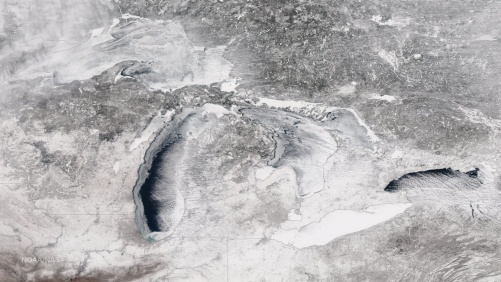
In this 2015 satellite image, the Great Lakes are almost completely covered in ice. A new study suggests that, during the last Ice Age, winds likely pushed lake-effect snow toward the lakes’ western shores instead of the eastern snowbelt cities familiar today. Photo courtesy of NOAA/NASA/NESDIS Environmental Visualization Laboratory
<関連情報>
- https://www.buffalo.edu/news/releases/2026/05/ancient-iceberg-scratches-reveal-a-reverse-snowbelt.html
- https://pubs.geoscienceworld.org/gsa/geology/article/doi/10.1130/G54750.1/730474/Icebergs-as-windvanes-Late-Pleistocene-iceberg
氷山は風向計の役割を果たす:五大湖東部における後期更新世の氷山による浸食痕は、氷河期の高気圧を記録している
Icebergs as windvanes: Late Pleistocene iceberg scours in the eastern Great Lakes record the glacial anticyclone
Sean P. Grasing;Jason P. Briner
Geology Published:May 05, 2026
DOI:https://doi.org/10.1130/G54750.1
Ice sheets and atmospheric circulation are tightly coupled, yet gaps remain in defining glacial anticyclonic wind patterns in both models and proxy data. Using high-resolution digital elevation models, we discovered >3000 relict iceberg scour marks on Late Pleistocene proglacial lake beds spanning >1000 km in the eastern Great Lakes, USA. We propose that iceberg scour marks spanning the last deglaciation (ca. 17−12 calibrated k.y. B.P.) act as paleowind proxies that record the anticyclonic wind system fronting the Laurentide Ice Sheet. Easterly winds steered iceberg drift, producing scour marks oriented WSW (258° ± 19°), the same general orientation as regional dune fields and longshore drift. Relict thermokarst lakes discovered in our study area are found to be impacted by the same wind system. Our discoveries provide the most extensive record of relict iceberg scour marks in the Great Lakes and offer evidence for sustained easterly winds driven by the Laurentide Ice Sheet glacial anticyclone fronting ∼5000 years of ice sheet recession.

