
2026-03-25 東京農業大学
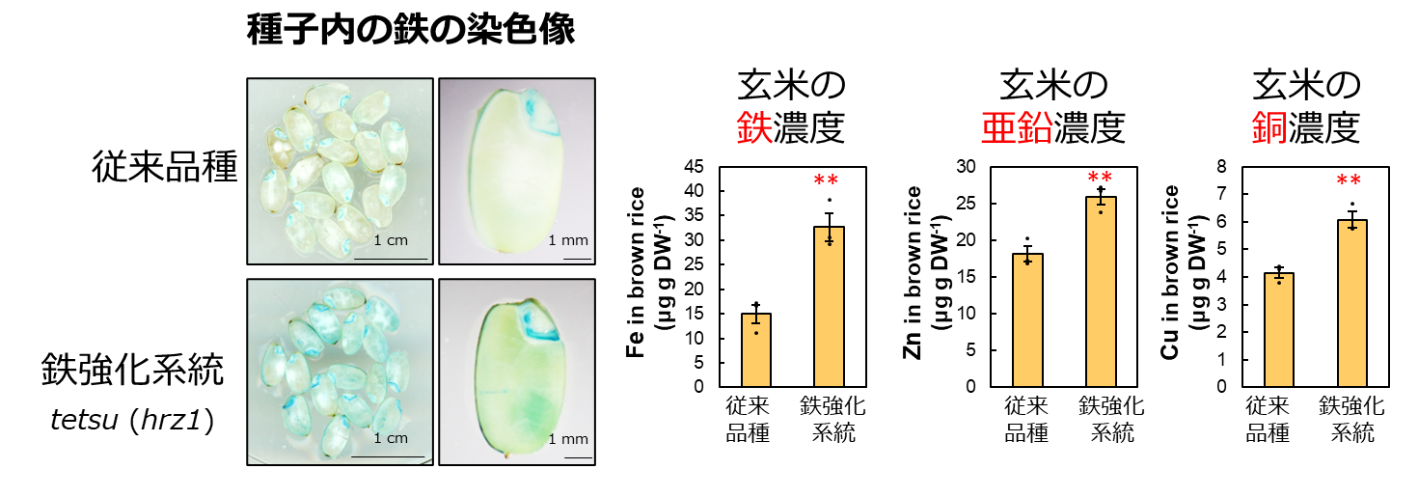
図1 鉄を多く含む新規イネ系統の作出 遺伝子変異により、玄米中の鉄が増加することを確認した。
左:鉄染色による玄米断面(青色が鉄)。右:玄米中の鉄・亜鉛・銅含量の比較。
遺伝子組換えを用いない栄養強化作物の開発につながる成果。
<関連情報>
- https://www.nodai.ac.jp/news/article/33251/
- https://link.springer.com/article/10.1186/s12284-026-00897-6
新規HRZ1変異体を用いた非遺伝子組み換え鉄強化イネ系統の確立 Establishment of a Non-transgenic Iron-Biofortified Rice Line Using a Novel HRZ1 Mutation
Akihiro Saito,Junya Kumano,Masataka Suzuki,Kento Nakamura,Hiromi Ichinokawa,Arata Higashimoto,Mai Kato,Kei Shimada,Sachiho Koshika,Satomi Nakayama,Nanami Kawano,Shunta Nishino,Takehiro Kobayashi,Haruka Nakamura,Kurumi Yamanaka,Ayane Konno,Rina Shimokawa,Ryoma Sugano,Shuhei Mukaida,Hayate Hata,Takuji Ohyama,Yusuke Shikanai,Toshihiro Kumamaru,Shimpei Uraguchi,… Kyoko Higuchi
Rice Published:13 March 2026
DOI:https://doi.org/10.1186/s12284-026-00897-6 Unedited version
Abstract
Iron (Fe) deficiency anemia is a significant public health problem worldwide. The development of Fe biofortification in staple food crops, such as rice, through non-transgenic methods is highly anticipated to enhance broad applicability. In this study, we isolated a high Fe-accumulating mutant (tetsu) from an N-methyl-N-nitrosourea (MNU) mutagenized ‘Taichung-65 (T65)’ rice population. The tetsu mutant accumulated more than 3-fold higher levels of Fe and significantly higher levels of manganese (Mn) and nickel (Ni) in the shoot than the wild-type (WT) T65, whereas the levels of toxic heavy metals such as cadmium (Cd), lead (Pb), and cobalt (Co) were comparable to those of the WT. In both polished and brown rice of the tetsu mutant, Fe increased by approximately 2-fold, and Zn and Cu also significantly increased compared with those in T65. Perls’ staining revealed that Fe localization in rice grains was not limited to the outer layers and scutellum, but also extended into the endosperm of the tetsu mutant. Concomitant with high Fe accumulation, the tetsu mutant showed remarkable tolerance to alkaline Fe-deficient soil conditions. Genotyping by Random Amplicon Sequencing-Direct (GRAS-Di) analysis revealed a novel nonsense mutation in the Hemerythrin motif-containing Ring Zinc-finger protein 1 (HRZ1) gene in the tetsu genome, which is known to govern the negative regulation of the Fe deficiency response and is crucial for normal development. The homozygous tetsu mutation leads to a substantial increase in shoot Fe content, alongside the upregulation of several genes related to Fe uptake and translocation, without causing serious adverse effects on growth. To utilize this novel mutation in Fe-biofortified rice breeding, we created recombinant inbred lines (RILs) derived from crosses between the tetsu mutant and ‘Asamurasaki,’ a nutrient-rich black rice cultivar. During the breeding process, we successfully selected RILs that exhibited normal growth and fertility, resulting in the development of non-transgenic Fe-biofortified rice lines with various waxy/glutinous properties and polyphenol content in brown rice for versatile applications. These results indicate that the identified novel HRZ1 mutation is a valuable target for engineering non-transgenic Fe-biofortified rice cultivars with various beneficial traits.

