2026-03-18 ワシントン州立大学(WSU)
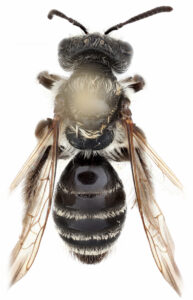
A view of the new mining bee species, Andrena cenizophila, identified by researchers from WSU, the Central Texas Melittological Institute, and the University of Kansas (photo courtesy of Silas Bossert, WSU).
<関連情報>
- https://news.wsu.edu/press-release/2026/03/18/scientists-discover-bee-species-that-depends-on-texas-shrub/
- https://journals.ku.edu/melittology/article/view/24606
テキサス州産のAndrena属(Labergeia ) の新種、その特異な開花期と花の宿主、およびLabergeia属(膜翅目:Andrenidae科) の再記載 A new species of Andrena (Labergeia) from Texas with an unusual phenology and floral host, including a redescription of Labergeia (Hymenoptera: Andrenidae)
Silas Bossert,Wyatt Zabinski,John L Neff
Journal of Melittology Published:24-02-2026
DOI:https://doi.org/10.17161/jom.vi141.24606
Abstract
Andrena is a species-rich genus of bees with a wide distribution, predominantly in the Holarctic. Here, we describe and illustrate a previously unknown species, Andrena (Labergeia) cenizophila Neff, Bossert & Zabinski n. sp., from southwestern Texas and central Coahuila, Mexico. Phylogenomic analyses recovered the new species as most closely related to Andrena (Labergeia) nahua Neff, a central Mexican species that was hitherto known only from the male sex. The discovery and examination of additional specimens of A. nahua allows us to describe and illustrate the previously unknown female, which shares diagnostic morphological features with the female of A. cenizophila n. sp. Based on these insights, we expand the diagnosis of Labergeia Neff to accommodate both species and discuss morphological affinities with their closest relatives in the subgenus Dactylandrena Viereck. Fossil-informed divergence time estimates indicates that Labergeia originated in the late Miocene, around 8 million years ago (5.37–11.82 mya), and that all known species of the subgenus, as well as its sister lineage Dactylandrena, are distributed in western and/or central North American. Lastly, we discuss the unusual foraging biology of A. cenizophila n. sp., which, based on observations and analyses of scopal pollen loads, is an oligolege of Leucophyllum frutescens (Berl.), I. M. Johnst. (Scrophulariaceae), a shrub commonly known as cenizo, Texas ranger, or Texas purple sage, among others. Interestingly, cenizo has a distinct floral phenology with comparatively short-termed mass blooms of not more than a week in duration, rendering it an unexpected choice for a specialist pollen collector. To our knowledge, A. cenizophila n. sp., is the only New World Andrena species that is oligolectic on plants of the family Scrophulariaceae.