2026-03-10 NASA
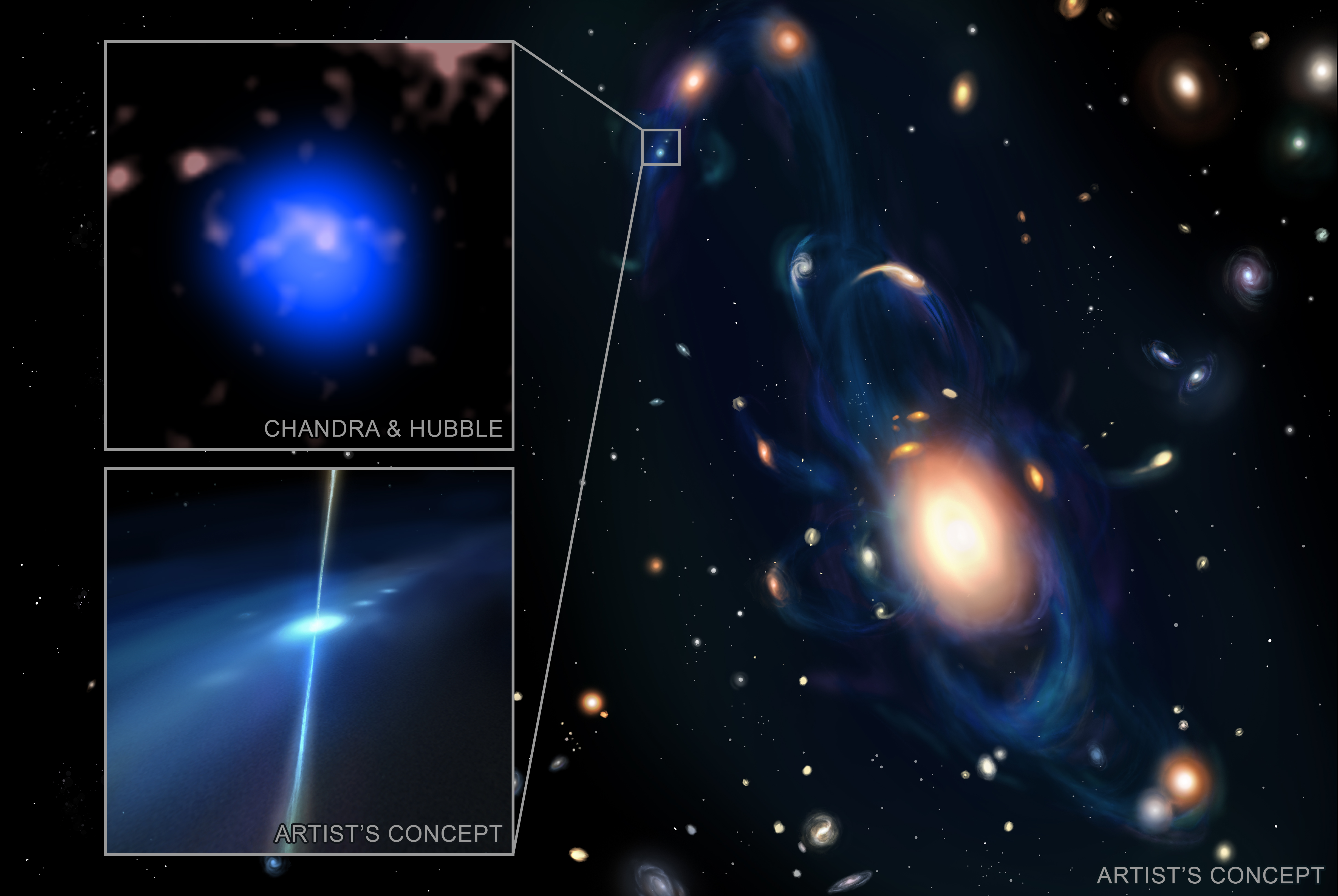
X-ray: NASA/CXC/Penn State Univ./S. Dichiara; IR: NASA/ESA/STScI; Illustration: ERC BHianca 2026 / Fortuna and Dichiara, CC BY-NC-SA 4.0; Image Processing: NASA/CXC/SAO/P. Edmonds
<関連情報>
- https://www.nasa.gov/missions/chandra/nasa-discovers-crash-of-extreme-stars-in-unexpected-site/
- https://iopscience.iop.org/article/10.3847/2041-8213/ae2a2f
合併の中の合併:チャンドラ衛星が特殊な環境下で短周期GRB 230906Aを特定 A Merger within a Merger: Chandra Pinpoints the Short GRB 230906A in a Peculiar Environment
S. Dichiara, E. Troja, B. O’Connor, Y.-H. Yang, P. Beniamini, A. Galvan-Gamez, T. Sakamoto, Y. Kawakubo, and J. C. Charlton
The Astrophysical Journal Letters Published: 2026 March 10
DOI:10.3847/2041-8213/ae2a2f
Abstract
We report the precise X-ray localization of GRB 230906A, a short-duration (T90 ∼ 0.9 s) gamma-ray burst (GRB) with no optical or radio counterpart. Deep imaging with the Hubble Space Telescope detects a faint galaxy (G*; F160W ≃ 26 AB mag) coincident with the subarcsecond X-ray position. Compared with standard GRB galaxies, its faintness, compact size, and color would suggest a high-redshift (z ≳ 3) host. However, our observations also reveal the presence of a galaxy group at z ∼ 0.453, confirmed spectroscopically with the Very Large Telescope/MUSE, with clear signs of interactions and mergers among group members. The GRB and its putative host project onto an extended (≈180 kpc) tidal tail emerging from the group’s central galaxy. The probability of a chance alignment is small (Pcc ≲ 4%); we thus argue that the GRB and its galaxy G* reside within the group. Their peculiar location along the tidal debris suggests that an enhanced burst of star formation, induced by the galaxy merger, might have formed the progenitor compact binary ≲700 Myr ago. The compact binary later evolved in a neutron star merger that produced GRB 230906A and injected r-process material into the surrounding circumgalactic medium.