2026-03-09 北海道大学
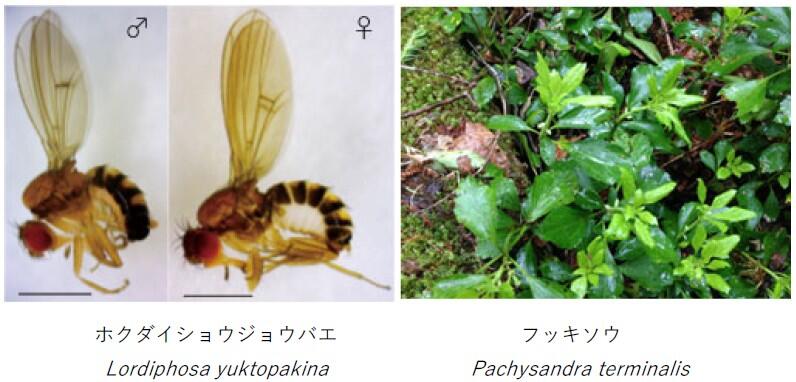
<関連情報>
- https://www.hokudai.ac.jp/news/2026/03/post-2209.html
- https://www.hokudai.ac.jp/news/pdf/260309_pr.pdf
- https://onlinelibrary.wiley.com/doi/abs/10.1111/ens.70005?msockid=14c04fdfd3d9603e282458cdd2a66128
ニセヒメショウジョウバエ属における寄主変更に伴う最近の種分化及び統合分類学に基づく新種記載Recent speciation with host change in the genus Lordiphosa Basden (Diptera: Drosophilidae) breeding on decayed herbaceous plants, with description of a new species based on integrative taxonomy
Kei Mitsuhashi, Hiroyuki F. Izumitani, Masanori J. Toda, Hide-aki Watabe, Yoshitaka Kamimura, Aya Takahashi, Jian-Jun Gao, Toru Katoh
Entomological Science Published: 27 February 2026
DOI:https://doi.org/10.1111/ens.70005
Abstract
We found a presumably new species that is closely related to Lordiphosa collinella but different from it in the range of host plants. Lordiphosa collinella is a generalist breeding on a wide variety of decayed herbaceous plants. In contrast, the new form almost specializes in breeding on Pachysandra terminalis. First, we delineate the latter specialist as a new species, Lordiphosa yuktopakina sp. nov. The hypothesis that they are sibling but distinct species is highly supported by studies of breeding ecology, morphology, genetic differentiation and reproductive isolation. Lordiphosa yuktopakina is estimated to have differentiated from L. collinella approximately 0.121 million years ago. For the ancestor of L. yuktopakina to use P. terminalis as an alternative host plant, the fly should have surmounted the hard texture of the host plant tissue. Lordiphosa yuktopakina has achieved this by making the ovipositor more robust and increasing the size of the cephalopharyngeal skeleton and the allometry of the mouth hook with larger teeth especially in the 1st instar larva. These adaptations to the newly acquired host plant should be reflected in the female reproductive traits. Thus, the two Lordiphosa species studied here provide a new instance of recent speciation with change and specialization to a particular host plant.