2026-02-28 中国科学院(CAS)
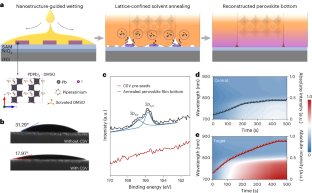
The mechanism of solvate crystal seeds at the buried interface. (Image by SUN Xiuhong)
<関連情報>
- https://english.cas.cn/newsroom/research-news/202602/t20260205_1149826.shtml
- https://www.nature.com/articles/s44160-026-00993-x
スケーラブルなペロブスカイト太陽電池製造のための結晶溶媒和物プレシード合成 Crystal-solvate pre-seeded synthesis for scalable perovskite solar cell fabrication
Xiuhong Sun,Mingwei Hao,Kaiyu Wang,Kuan Wang,Yalan Zhang,Bingqian Zhang,Xuexuan Huang,Chenghao Bi,Shuping Pang & Yuanyuan Zhou
Nature Synthesis Published:27 February 2026
DOI:https://doi.org/10.1038/s44160-026-00993-x
Abstract
Buried morphological and electronic defects of solution-synthesized perovskite films are detrimental to the photovoltaic stability and performance of state-of-the-art inverted perovskite solar cells based on self-assembled monolayers (SAMs). Previous studies have attempted to alleviate this synthesis issue by molecular tailoring of SAMs. Here we use pre-seeding of low-dimensional halide crystal solvates (CSVs) to trigger the formation of perovskite film bottoms with suppressed morphological and electronic defects. CSVs enable nanostructure-guided wetting of the perovskite precursor solution on SAMs and unlock lattice-confined solvent annealing of the perovskite film bottom, mitigating interfacial voids and nanogrooves. This method also leads to CSV-derived halide compound passivation at the film bottom, reducing electronic defects and enabling hole-extraction-favouring interfacial energetics. The sequential multi-functionality enabled by CSV pre-seeding surpasses the nucleation control in conventional seeding strategies. Resultant inverted perovskite solar cells deliver a power conversion efficiency of 26.13% with a high fill factor of 86.75%. These devices demonstrate improved light and thermal stabilities under ISOS-L-1 and ISOS-T-1 test protocols. The scalability of CSV pre-seeding is demonstrated with 23.15% power conversion efficiency achieved for a 49.91 cm2 perovskite solar mini-module.