

2026-02-02 ハーバード大学
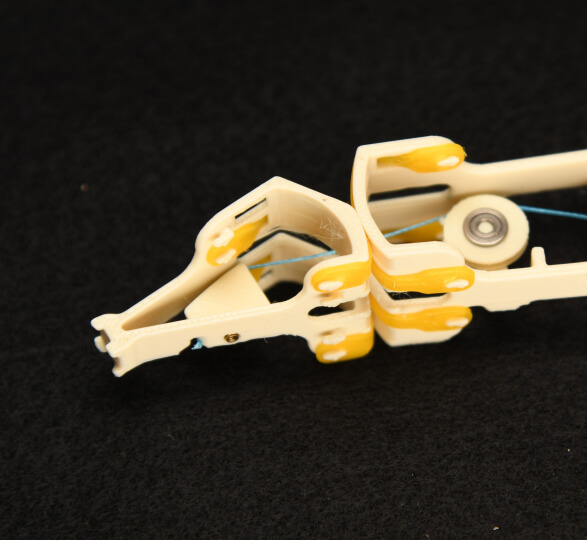
An optimized rolling contact joint.
<関連情報>
- https://seas.harvard.edu/news/optimizing-robotic-joints
- https://www.pnas.org/doi/10.1073/pnas.2521406123
非円形転がり接触ジョイントはロボットリンクのプログラムされた動作を可能にする Noncircular rolling contact joints enable programmed behavior in robotic linkages
Colter J. Decker, Tony G. Chen, Michelle C. Yuen, and Robert J. Wood
Proceedings of the National Academy of Sciences Published:February 2, 2026
DOI:https://doi.org/10.1073/pnas.2521406123
Significance
We describe an optimization routine to design rolling contact joints with customized kinematics. This compact and robust mechanism can be “programmed” with desired end-effector paths and variable mechanical transmission ratios while maintaining flexibility in off-axis directions. This hybrid system of rigid links and flexible joints results in mechanisms that are robust to impacts, while maintaining precise controllability and high load-bearing capacities. The programmability of the joints allow them to closely match desired paths such as the biomechanics of humans or animals, potentially improving assistive devices and bioinspired robots. The flexible optimization routine can be modified to generate multijoint kinematic chains coupled to a single actuation input, as well as passive joints coupled with elastic elements to create nonlinear springs.
Abstract
Rolling contact joints (RCJs) guide motion in robotic linkages, including manipulators, surgical devices, prosthetics, and more. In this work, we present a generalized optimization method to tailor the kinematic properties of RCJs by simultaneously optimizing both noncircular surface geometries and internal actuation pulley shapes. Our approach accommodates multiple joint types, including passively coupled systems with programmable spring stiffness as well as actuated single or multilink mechanisms. We explicitly incorporate common and practical manufacturing constraints into our optimization framework, such as size and convexity constraints. To demonstrate this approach, we optimize an RCJ designed to replicate the trajectory of a human knee, achieving a 99.6% reduction in alignment error compared to revolute joints and a 99.3% error reduction compared to circular RCJs. Additionally, we show that optimized RCJs increase the load-carrying capacity of a two-finger gripper by more than 3.5 times compared to a comparable circular-jointed design, showcasing how joint optimization can enhance robotic performance.

