2026-02-02 ブラウン大学
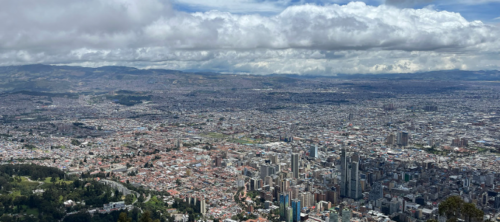
The Bogotá Basin, home to 11 million people, may experience higher temperatures than scientists thought previously as the planet warms. Credit: Lina Pérez-Ángel
<関連情報>
- https://www.brown.edu/news/2026-02-02/tropical-warming-co2
- https://www.pnas.org/doi/10.1073/pnas.2520191123
鮮新世・更新世における熱帯アンデス陸生気温増幅の進化 Evolution of Pliocene-Pleistocene tropical terrestrial Andean temperature amplification
Lina C. Pérez-Angel, Julio Sepúlveda, Peter Molnar, +10 , and Robin B. Trayler
Proceedings of the National Academy of Sciences Published:February 2, 2026
DOI:https://doi.org/10.1073/pnas.2520191123
Significance
The tropics are home to 40% of the world’s population, and countries in the tropics are ill-equipped to adapt to future climate change. While the Pliocene epoch is one of the best climatic analogues to explore present and future change, it remains understudied in the tropics. We present a temperature record from the northern tropical Andes, at 4°N of the equator, and show that land temperature changes are similar to, but larger than ocean temperatures over ~4 My. The “excess” in temperature response on tropical land points to important regional feedbacks that may amplify climate change in the future.
Abstract
The Pliocene is the most recent epoch in which the Earth warmed under atmospheric CO2 levels similar to today (>400 ppm). The Pliocene then transitioned to the colder Pleistocene epoch, with the initiation of large-scale Northern Hemisphere glaciations. Although ocean temperature changes across these epochs are relatively well-known, quantitative estimates of the magnitude of land temperature change in the tropics are scarce. We provide a Plio-Quaternary quantitative air temperature record based on the distribution of bacterial branched glycerol dialkyl glycerol tetraethers (brGDGTs) preserved in sediments of the Funza-II core in the Sabana de Bogotá, Colombia (~4°N). Using a refined age model based on new U-Pb zircon dates from ash layers, and a novel mixed-source model that disentangles contributions from lake- and soil-derived brGDGTs, we show that warm Pliocene (3.8 to 2.58 Ma) temperatures were 4.8+1.8-1.4 °C warmer than the last ~800,000 y of the colder Pleistocene. The evolution of Pliocene-Pleistocene temperature in our record largely mirrors long-term tropical sea surface temperature (SST) cooling, highlighting the linkages between sea and land temperatures in the low latitudes via greenhouse-gas forcing. The median amplitude of Pliocene-Pleistocene cooling in the northern tropical Andes exceeds that predicted by theory, highlighting the importance of regional feedbacks including lapse rate adjustments and/or changes in Pacific SST gradients to the long-term evolution of Andean temperature. This first quantitative terrestrial temperature reconstruction within 5° of the equator over the past 3.8 My highlights that both regional and global processes must be considered when constraining uncertainties for future warming scenarios.