2026-01-21 中国科学院(CAS)
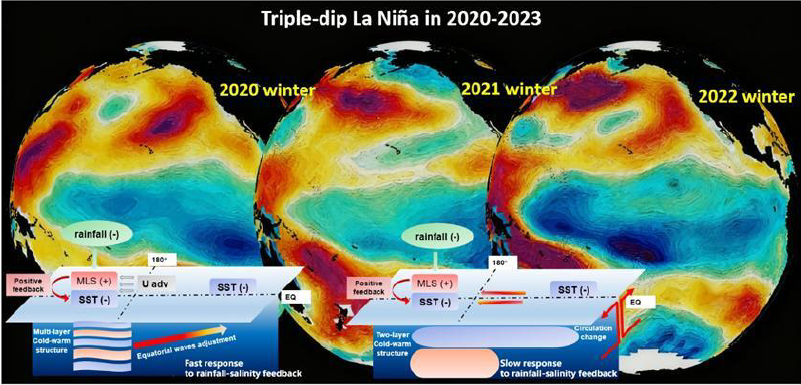
The role of salinity feedback caused by reduced rainfall in sustaining multi-year La Niña events. (Image by IOCAS)
<関連情報>
- https://english.cas.cn/newsroom/research_news/earth/202601/t20260121_1146304.shtml
- https://www.nature.com/articles/s41467-026-68451-y
降雨により数年にわたるラニーニャ現象が続く Rainfall sustains multiyear La Niña
Feng Tian,Rong-Hua Zhang,Chuanyu Liu & Cong Guan
Nature Communications Published:14 January 2026
DOI:https://doi.org/10.1038/s41467-026-68451-y Unedited version
Abstract
Historical observations and climate models indicate that multiyear La Niña events are growing more frequent. These prolonged events cumulatively alter tropical Pacific rainfall, which in turn affects regional mixed-layer salinity (MLS). However, how cumulative rainfall anomalies modulate multiyear La Niña through salinity effects remains unclear. Here, using observations and model experiments, we show that the positive MLS anomalies in the western–central equatorial Pacific—driven initially by oceanic dynamical processes and later by rainfall deficits during multiyear La Niña—reinforce these prolonged La Niña events. Quantitatively, the rainfall reduction enhances La Niña amplitude by 14% in the first year and 32% in the second year. MLS anomalies in the western–central equatorial Pacific initially trigger equatorial Kelvin wave adjustments, causing rapid surface cooling in the eastern equatorial Pacific. Subsequent slow ocean circulation responses lead to basin-wide equatorial Pacific cooling. The superposition of rapid and slow oceanic responses creates cumulative positive feedback from rainfall on the second-year La Niña. These findings identify rainfall–salinity feedbacks as a key mechanism sustaining multiyear La Niña events, with implications for ENSO prediction and hydrological cycle.