2026-01-14 東京科学大学
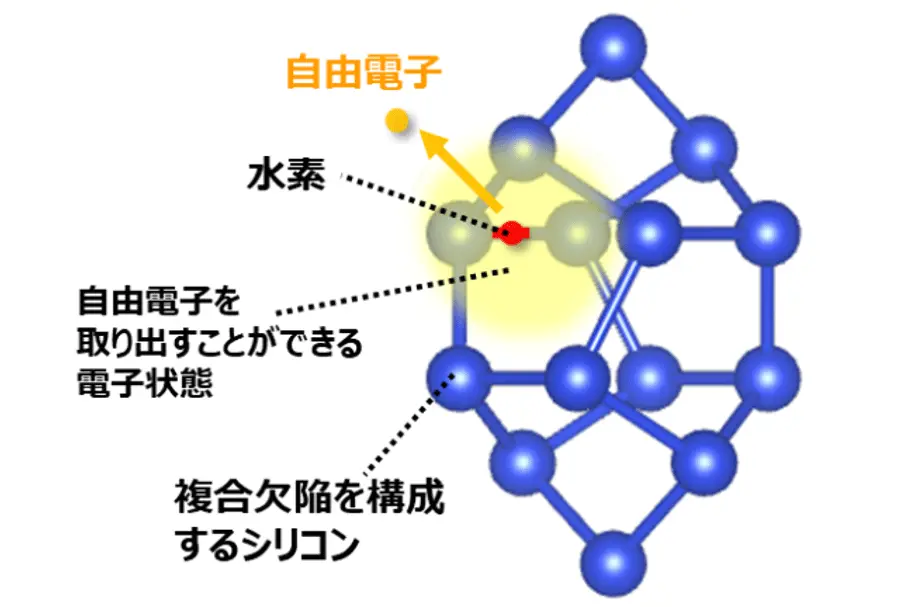
シリコンに注入した水素が自由電子を生成するメカニズム
<関連情報>
- https://www.isct.ac.jp/ja/news/6b72n8py9lfe
- https://www.isct.ac.jp/plugins/cms/component_download_file.php?type=2&pageId=&contentsId=1&contentsDataId=3045&prevId=&key=d6f161495ef0f8a4e9ace74f682d0912.pdf
- https://www.nature.com/articles/s43246-025-00955-4
水素-欠陥相互作用による半導体のN型ドーピングの進歩 Advancing N-type doping in semiconductors through hydrogen-defect interactions
Akira Kiyoi,Yusuke Nishiya,Yuichiro Matsushita & Takahide Umeda
Communications Materials Published:13 January 2026
DOI:https://doi.org/10.1038/s43246-025-00955-4
Abstract
Doping, a critical technology in semiconductor device fabrication, is conventionally realized using substitutional impurities as dopants. New ideas and breakthroughs can help realize wide-bandgap materials with unconventional dopants. In this study, we explored a novel n-type doping mechanism using the donor nature of hydrogen-related donors in silicon to address the limitations of conventional doping. Certain defects, such as interstitial-type defects, create defect levels near the conduction band edge, which function as “empty donor levels.” The association of hydrogen with these defects generates free electrons through the transfer of an electron from the hydrogen atom to this empty level. This synergistic approach of hydrogen and defects can be demonstrated reliably and controllably in state-of-the-art Si devices. The mechanism, revealed by density functional theoretical calculation and EPR experiments, potentially expands this approach to other materials, providing a novel method for device optimization such as the realization of low-resistivity contacts.