
2025-12-12 ペンシルベニア州立大学(Penn State)
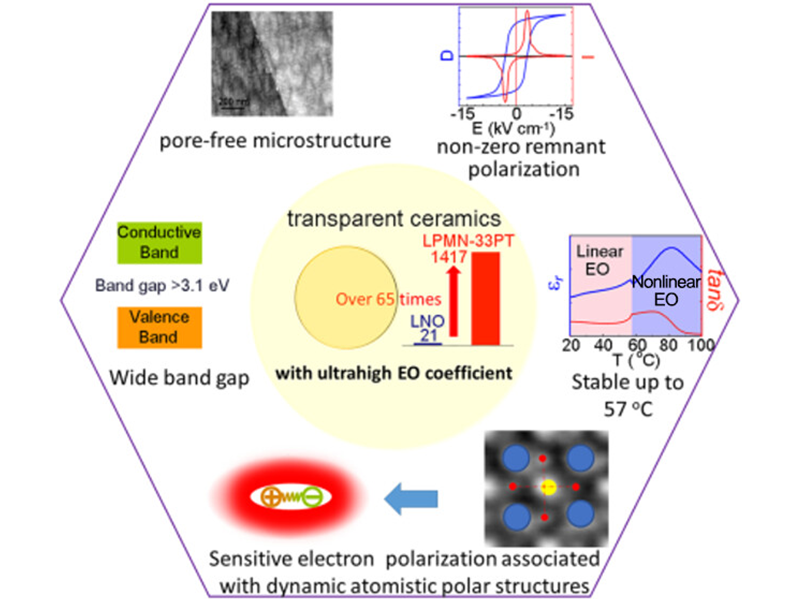
A new physics theory called zentropy could help explain why recently developed transparent ceramics control light far better than expected, a discovery that could lead to faster, smaller and more energy-efficient optical technologies used in communications, sensing and medical imaging. Credit: Zi-Kui Liu/Phases Research Lab. All Rights Reserved.
<関連情報>
- https://www.psu.edu/news/materials-research-institute/story/transparent-ceramic-could-boost-internet-speeds-and-cut-energy
- https://pubs.acs.org/doi/10.1021/jacs.5c15699
透明強誘電体セラミックスの超高線形電気光学係数を支える動的原子極性構造 Dynamic Atomistic Polar Structure Underpins Ultrahigh Linear Electro-Optic Coefficient in Transparent Ferroelectric Ceramics
Qinghui Jiang,Weigang Zhao,Man Zhang,Jian-Ping Zhou,Mingqing Liao,Andriy Smolyanyuk,Zixuan Wu,Chenglong Jia,Xiaoyong Wei,Cedric Weber,Nadezda V. Tarakina,Isaac Abrahams,Jan M. Tomczak,Zi-Kui Liu,Vladimir Roddatis,and Haixue Yan
Journal of the American Chemical Society Published: November 4, 2025
DOI:https://doi.org/10.1021/jacs.5c15699
Abstract
Transparent ferroelectrics with high linear electro-optic (EO) coefficients are critical for advanced electro-optical devices. However, achieving optical transparency in ferroelectric ceramics remains challenging due to visible light scattering caused by defects such as domain walls, grain boundaries, and pores. Here, we report the successful fabrication of transparent ferroelectric ceramics through innovative chemical composition design and an advanced two-step sintering process in the La-doped Pb(Mg1/3Nb2/3)O3–PbTiO3 system. The optical transparency, which is near the theoretical upper limit, can be attributed to the wide band gap and the minimization of light scattering of defects. By minimizing porosity and engineering grain/domain sizes to differ significantly from the wavelengths of visible light, we suppress scattering, achieving optical transparency near the theoretical upper limit. Strikingly, these ceramics exhibit an ultrahigh linear EO coefficient of ∼1417 pm/V, over 65 times greater than that of LiNbO3 single crystals, the current industry standard. We attribute this exceptional performance to dynamic atomistic polar structures within switchable, thermally stable domains, which enhance electronic polarization sensitivity. This mechanism is corroborated by dielectric spectroscopy, high-resolution transmission electron microscopy and simulation. Our findings offer insights into the design of cost-effective transparent materials with exceptional EO properties, paving the way for next-generation electro-optical devices.

