2025-12-09 スイス連邦工科大学ローザンヌ校(EPFL)
<関連情報>
- https://actu.epfl.ch/news/the-twisted-nanotubes-that-tell-a-story-2/
- https://www.nature.com/articles/s41565-025-02055-3
ゼロ磁場における非カイラル強磁性体における幾何学誘起スピンカイラリティ Geometry-induced spin chirality in a non-chiral ferromagnet at zero field
Mingran Xu,Axel J. M. Deenen,Huixin Guo,Pamela Morales-Fernández,Sebastian Wintz,Elina Zhakina,Markus Weigand,Claire Donnelly & Dirk Grundler
Nature Nanotechnology Published: 04 December 2025
DOI:https://doi.org/10.1038/s41565-025-02055-3
Abstract
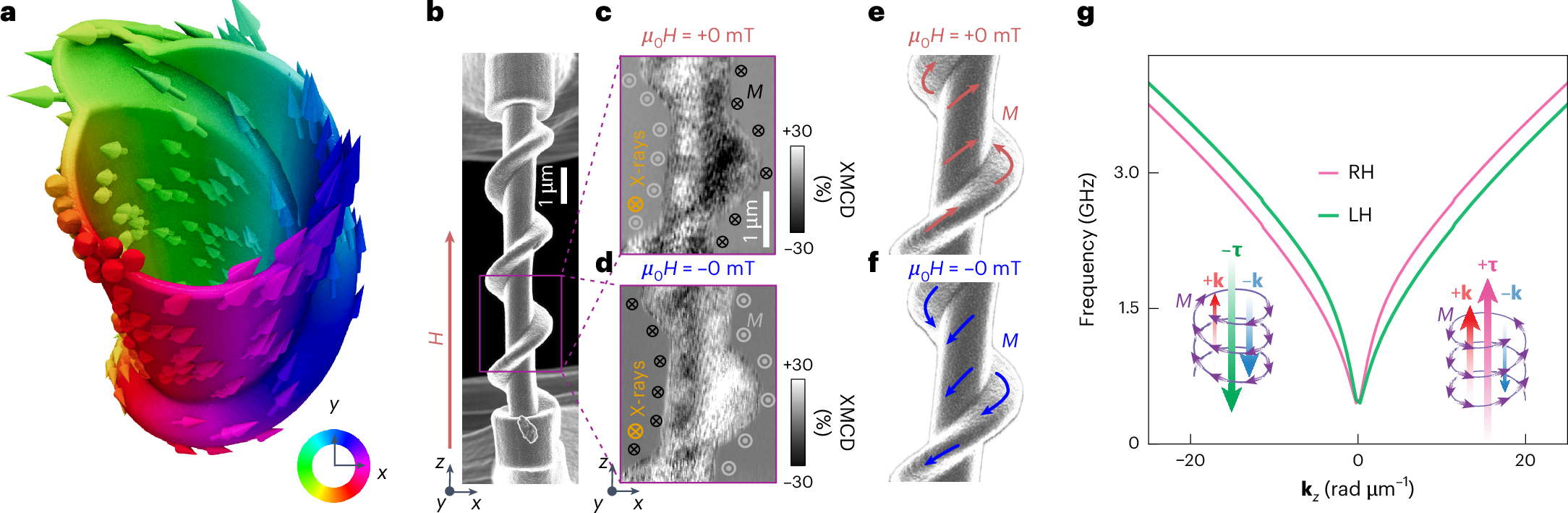
Spin chirality is a fundamental property that manifests non-reciprocal transport—magnetochiral anisotropy (MChA). However, the application of MChA in technology is constrained by the necessity for an external magnetic field, complex non-centrosymmetric crystal synthesis and cryogenic environments. Here we overcome these challenges by imprinting geometric chirality onto a nickel tube via three-dimensional nanoengineering. We use two-photon lithography to create a structurally twisted polymeric template with micrometre-sized pitch and diameters and cover it with a uniform 30-nm-thick nickel shell. The nickel tube exhibits spontaneous MChA—non-reciprocal transport at zero magnetic field and room temperature. X-ray magnetic circular dichroism microscopy confirms helical spin textures stabilized by the torsion- and curvature-engineered shape anisotropy, while inelastic light scattering spectroscopy demonstrates robust non-reciprocal magnon transport at remanence, reconfigurable via magnetic field history. The chiral parameter in our device surpasses that of natural chiral magnets such as Cu2OSeO3. Analytical theory and micromagnetic simulations demonstrate that the non-reciprocity is further enhanced by downscaling the feature sizes. Our results establish a scalable, geometry-driven nanotechnology that imprints spin chirality on non-chiral ferromagnets and may enable nanoscale integration of chirality-enhanced magnonics and spintronics for real-world use cases.