2025-12-02 バッファロー大学
<関連情報>
- https://www.buffalo.edu/news/releases/2025/12/tracking-forever-chemicals-across-food-web.html
- https://pubs.acs.org/doi/10.1021/acs.jafc.5c08608
PFAS異性体は重要:サイクリックイオンモビリティ分離法によって明らかになった、消費される魚類中の直鎖および分岐PFOSとPFOAの分布パターン PFAS Isomers Matter: Distribution Patterns of Linear and Branched PFOS and PFOA in Consumed Fish Revealed by Cyclic Ion Mobility Separation
Mindula K. Wijayahena,Rawikan Kachangoon,Cheyanne Witmer,Joshua S. Wallace,Jitlada Vichapong,and Diana S. Aga
Journal of Agricultural and Food Chemistry Published: October 6, 2025
DOI:https://doi.org/10.1021/acs.jafc.5c08608
Abstract
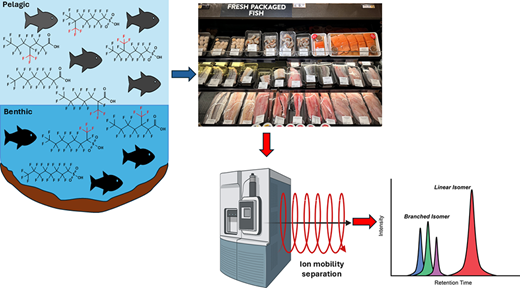
The occurrence of per- and polyfluoroalkyl substances (PFAS), including the isomers of perfluorooctanesulfonic acid (PFOS) and perfluorooctanoic acid (PFOA), in market fish species from both benthic and pelagic habitats was assessed. Thirteen PFAS were detected, with PFOS and PFOA present in all samples; PFOA showed the highest median concentration (1.21 ng/g ww). The total PFAS concentration ranged from 1.29 ng/g ww (in tilapia) to 5.37 ng/g ww (in rainbow trout). Ion mobility spectrometry (IMS) revealed habitat-specific PFOS isomer patterns: benthic fish contained linear and all the monosubstituted isomers, while pelagic fish showed linear and fewer monosubstituted types. The median concentration of linear PFOS was 0.445 ng/g ww, with cod exhibiting the highest level at 0.670 ng/g ww, and tilapia the lowest at 0.30 ng/g ww. IMS enabled the first-ever identification of PFOA isomers in fish. These findings underscore the importance of isomer-specific PFAS resolution for dietary risk assessments and shape guidelines.