2025-11-07 中国科学院(CAS)
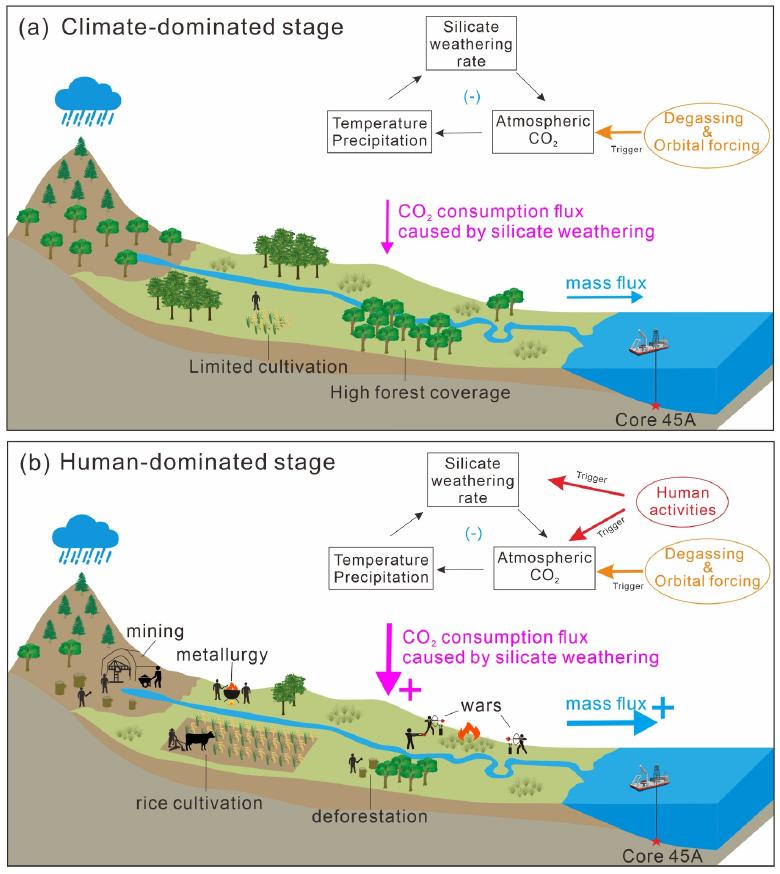
Schematic diagrams show the two stages of silicate weathering dominated by climate and human activities. (Image by IOCAS)
<関連情報>
- https://english.cas.cn/newsroom/research_news/earth/202511/t20251107_1097909.shtml
- https://agupubs.onlinelibrary.wiley.com/doi/10.1029/2025JF008433
人間活動は紅河流域における珪酸塩風化の強化を引き起こした:後期完新世における炭素吸収源の拡大 Human Activities Induced Stronger Silicate Weathering in the Red River Basin: A Growing Carbon Sink During the Late Holocene
Xiaowei Wang, Shiming Wan, Peter D. Clift, Debo Zhao, Guanqiang Cai, Yifei Yang, Jin Zhang, Zhaojie Yu, Hualong Jin, Zehua Song, Yi Tang, Shuo Zhang, Anchun Li
Journal of Geophysical Research: Earth Surface Published: 24 October 2025
DOI:https://doi.org/10.1029/2025JF008433
Abstract
Silicate weathering is essential for the global carbon cycle and is a driver of climate change through the consumption of atmospheric CO2. Recent studies have pointed out that silicate weathering in the late Holocene was widely influenced by human activities, but the carbon sink effect of silicate weathering under anthropogenic influence remains unclear. In this study, we present continuous records of clay minerals, major elements, and terrigenous mass accumulation rates of Core 45A in the Western South China Sea to reconstruct the evolutionary history of weathering and erosion in the Red River Basin since 3800 cal yr BP. We investigate the interactions between weathering, climate, and human activities. Our results reveal that the silicate weathering intensity and erosion rate have increased significantly since ∼1500 cal yr BP, which is decoupled from the trend to a cooler and drier climate but coincides well with stronger human activities, suggesting the significance of anthropogenic influence on silicate weathering. We also reconstruct the CO2 consumption flux induced by silicate weathering to quantitatively evaluate the impact of human activities on the carbon sink capacity of silicate weathering. The calculated CO2 consumption fluxes contributed by anthropogenic activities on silicate weathering show an approximate 150% increase compared to natural conditions in the Red River. Thus, this study highlights that human-enhanced silicate weathering has reduced atmospheric CO2 and played an important role in the global carbon cycle during the late Holocene, which has never occurred in the Earth’s geological past.
Plain Language Summary
Human activities, particularly farming and deforestation, significantly affect silicate weathering, which is a key geological process for atmospheric CO2 sequestration. However, the extent to which humans have accelerated silicate weathering and associated CO2 consumption remains unclear. The sediment records in the Western South China Sea were used to reconstruct the history of erosion and weathering in the Red River Basin during the past 3,800 years and to quantitatively estimate the CO2 consumption flux caused by silicate weathering. We suggest that human activities rather than natural climate have been the main driver of the strengthened silicate weathering over the past 1,500 years. The anthropogenically induced CO2 consumption flux shows a 150% increase relative to natural conditions. These findings reveal that human societies not only act as major carbon emitters but also substantially modify Earth’s natural carbon sink capacity through weathering enhancement. Our work highlights the dual role of anthropogenic forcing in the global carbon cycle and provides critical insights into human-altered weathering processes at continental scales.
Key Points
- Human activities have enhanced silicate weathering intensity and erosion rate in the Red River Basin since ∼1500 cal yr BP
- Human activities increase CO2 consumption flux caused by silicate weathering by 150% compared to natural conditions in the Red River
- Human-enhanced silicate weathering acts as a growing carbon sink and has played a key role in the carbon cycle during the late Holocene