2025-11-04 ジョージア工科大学(Georgia Tech)
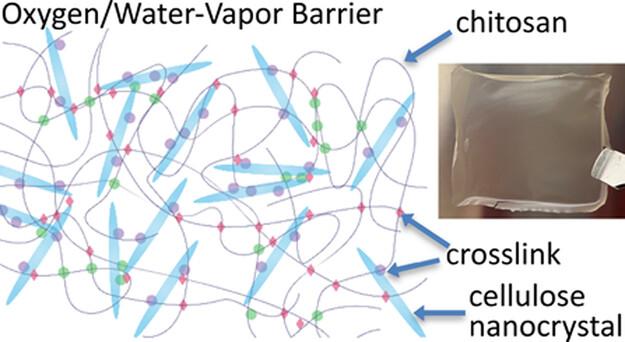
A biologically based film made from natural ingredients found in plants, mushrooms, and food waste
<関連情報>
- https://research.gatech.edu/researchers-develop-biobased-film-could-replace-traditional-plastic-packaging
- https://pubs.acs.org/doi/10.1021/acsapm.5c02909
再生可能な炭水化物ベースのポリマーを高湿度下での酸素・水分バリアに変える Transforming Renewable Carbohydrate-Based Polymers into Oxygen and Moisture Barriers at Elevated Humidity
Yang Lu,Javaz T. Rolle,Tanner Hickman,Yue Ji,Eric Klingenberg,Natalie Stingelin,and J. Carson Meredith
ACS Applied Polymer Materials Published: October 23, 2025
DOI:https://doi.org/10.1021/acsapm.5c02909
Abstract
The widespread usage of nonrenewable plastics in packaging has resulted in a significant environmental burden, and the industry is working to adopt renewable biopolymers in place of traditional plastics. However, renewable biopolymers often lack sufficient gas-barrier properties at an elevated relative humidity (RH). Here, we demonstrate that the introduction of citric acid (CA) cross-linkers to cellulose nanocrystal (CNC)/chitosan (Ch) blends significantly reduces the oxygen permeability (OP) and water vapor transmission rate (WVTR) at high RH. Specifically, in CNC/Ch binary systems (without CA), as in many plastic packaging materials, the OP value increases dramatically (approximately 45×) when increasing RH from 50 to 80%. In contrast, CNC/Ch/CA ternaries feature low OP of 0.59 cm3 μm·m–2 day–1 kPa–1 at 23 °C/80% RH, similar to the OP at 50% RH. This ternary system, with additional heat treatment, also exhibits an extremely low thickness-normalized WVTR of 0.005 g·mm·m–2 day–1 at 23 °C and 50% RH. The WVTR rises to 14 g·mm·m–2 day–1 at 38 °C/80% RH, still approximately 10× lower than that of neat CNCs.