2025-11-06 国際農研,ブルキナファソ国立農業環境研究所
Web要約 の発言:
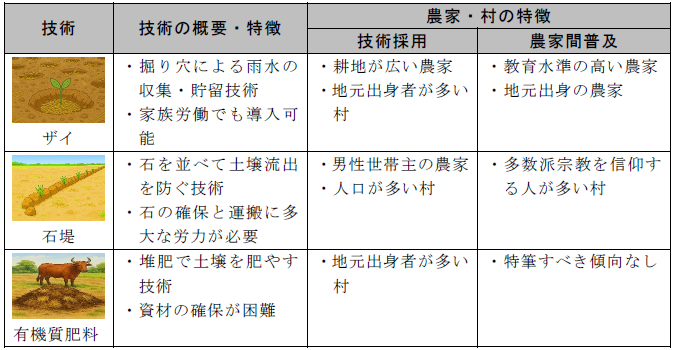
表1 技術採用・農家間普及における土壌保全技術間の差異分析
<関連情報>
- https://www.jircas.go.jp/ja/release/2025/press202519
- https://www.jircas.go.jp/system/files/press/press202519_0.pdf
- https://onlinelibrary.wiley.com/doi/10.1002/ldr.70136
ブルキナファソのソルガム農家における土壌保全技術の導入と普及:イノベーション、ネットワーク、リスク回避の視点 The Adoption and Dissemination of Soil Conservation Technologies Among Sorghum Farmers in Burkina Faso: Perspectives on Innovation, Network, and Risk Aversion
Guenwoo Lee, Evéline M. F. W. Sawadogo-Compaoré, Kenta Ikazaki, Rie Muraoka
Land Degradation & Development Published: 15 August 2025
DOI:https://doi.org/10.1002/ldr.70136
ABSTRACT
Soil degradation threatens agricultural productivity across Africa, necessitating effective conservation strategies. However, gaps remain in understanding the mechanisms that drive agricultural technology adoption and dissemination. This study applies the theories of innovation diffusion, social networks, and risk aversion to examine the adoption and dissemination of Zaï pits, stone lines, and organic manure among sorghum farmers in Burkina Faso. The results reveal that Zaï adoption is strongly associated with farm size. A one-unit increase in log landholding raises the likelihood of adoption by 8%. This finding supports the diffusion theory, which states that resource-rich farmers absorb risk and benefit more. Moreover, social networks are significant. Each one-percentage-point increase in native residents boosts adoption by 0.77–0.80 points. Furthermore, native household heads are 12 percentage points more likely to share Zaï and advise an average of 7.7 more peers. Each additional level of education completed adds an average of 2.18 peer advisories. Extension-informed farmers advise an average of 15 peers, demonstrating that homophily and knowledge networks drive diffusion. However, risk aversion has a minimal impact, with 0.3 fewer peer advisories (less than 1%) and no significant effect on Zaï, stone line, or manure use. Stone line adoption is more common in male-headed households, likely due to labor requirements, whereas organic manure use depends on land and village composition rather than innovativeness or risk attitude. These findings suggest that enhancing structural supports, such as land access, education, and extension, and leveraging community networks benefit scaling conservation practices more than shifting farmers’ risk preferences.