2025-10-22 早稲田大学
<関連情報>
- https://www.waseda.jp/inst/research/news/82615
- https://pubs.rsc.org/en/content/articlelanding/2025/dd/d5dd00304k
機械学習に基づく格子サンプリングと構造緩和による有機分子の結晶構造予測 Crystal structure prediction of organic molecules by machine learning-based lattice sampling and structure relaxation
Takuya Taniguchi and Ryo Fukasawa
Digital Discovery Published:13 Oct 2025
DOI:https://doi.org/10.1039/D5DD00304K
Abstract
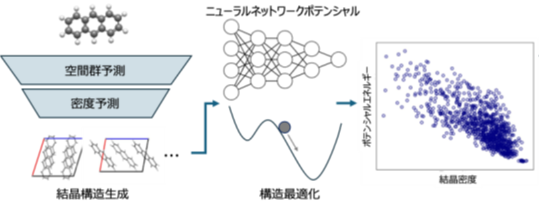
Predicting the crystal structures of organic molecules remains a formidable challenge due to intensive computational cost. To address this issue, we developed a crystal structure prediction (CSP) workflow that combines machine learning-based lattice sampling with structure relaxation via a neural network potential. The lattice sampling employs two machine learning models—space group and packing density predictors—that reduce the generation of low-density, less-stable structures. In tests on 20 organic crystals of varying complexity, our approach achieved an 80% success rate—twice that of a random CSP—demonstrating its effectiveness in narrowing the search space and increasing the probability of finding the experimentally observed crystal structure. We also characterized which molecular and crystal parameters influence the success rate of CSP, clarifying the effectiveness and limitation of the current workflow. This study underscores the utility of combining machine learning models with efficient structure relaxations to accelerate organic crystal structure discovery.