2025-10-22 中国科学院(CAS)
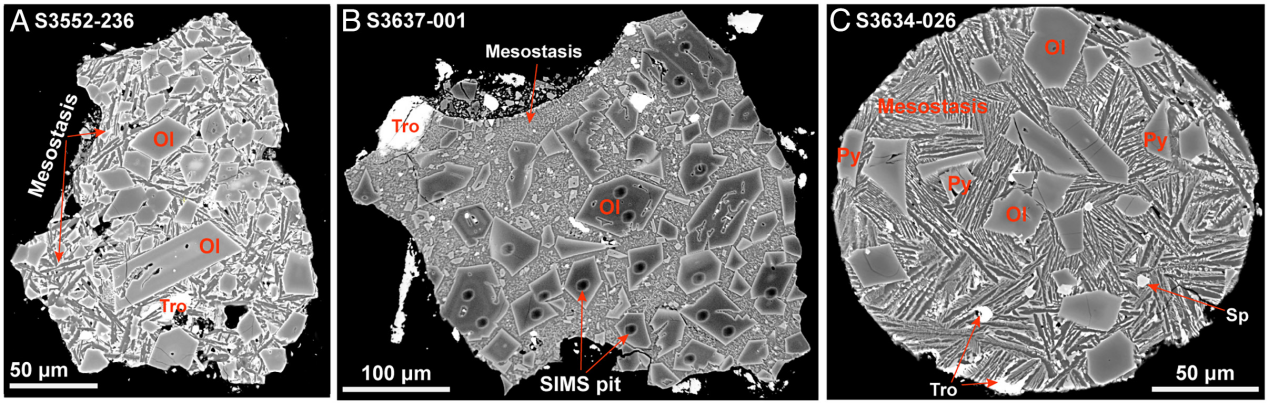
Relics of the impactor identified in the Chang’e-6 lunar regolith. (Image by Prof. XU Yigang’s team)
<関連情報>
- https://english.cas.cn/newsroom/research_news/earth/202510/t20251022_1089997.shtml
- https://www.pnas.org/doi/10.1073/pnas.2501614122
嫦娥6号の月サンプルにCI型コンドライトの衝突遺物を発見 Impactor relics of CI-like chondrites in Chang’e-6 lunar samples
Jintuan Wang, Zhiming Chen, Zexian Cui, +17 , and Yi-Gang Xu
Proceedings of the National Academy of Sciences Published:October 20, 2025
DOI:https://doi.org/10.1073/pnas.2501614122
Significance
We found seven olivine-bearing fragments in lunar samples returned by the Chang’e-6 mission from a huge, ancient (pre-Nectarian) basin on the far-side of the Moon. We identified these uncommon clasts as remnants of carbonaceous Ivuna-like (CI) carbonaceous chondrites similar to asteroids Ryugu and Bennu based on olivine elemental and isotopic compositions. As CI chondrites are rich in water and volatiles, this finding supports the hypothesis that asteroids played a role in delivering water and other volatiles to the lunar surface. Given the rarity of CI chondrites in Earth’s meteorite collection, our integrated methodology for identifying exogenous materials in lunar and potentially other returned samples offers a valuable tool for reassessing chondrite proportions in the inner Solar System.
Abstract
The impact history of the Moon provides the opportunity to better understand mass transfer in the Solar System. While Earth’s meteorite collection serves as a key reference for material flux in the Earth–Moon system, it suffers from profound biases arising from Earth’s orbital dynamics and atmospheric filtering. Systematic identification and classification of meteorites on the airless Moon thus provide additional critical constraints for reconstructing the primordial accretion history and impactor population of the inner Solar System. However, identifying impactors on the Moon remains challenging due to their vaporization upon colliding at high velocities with the lunar surface. In situ remote sensing has previously detected chondritic impactor materials in the South-Pole-Aitken (SPA) basin of the far side of the Moon. The first opportunity to measure materials from the SPA basin has come via the Chang’e-6 (CE-6) mission, which returned samples from the Apollo basin inside the SPA basin. In this study, we screened seven olivine-porphyritic clasts as potential impactor relics in regolith returned by the CE-6 mission. These clasts were identified, via textural characterization, olivine Fe–Mn–Zn systematics, and in-situ triple oxygen isotopes, as impact relics solidified from melted chondritic parent bodies. Intriguingly, the parent body of all the identified impactor relics in this study resemble CI-like chondrites, a volatile-rich meteorite group that is relatively rare in Earth’s meteorite collection. The detection and classification of these impactor relics impose significant constraints on the proportions of meteoritic materials in the Earth–Moon system and their potential contributions to water inventories on the lunar surface.