2025-10-14 ハーバード大学
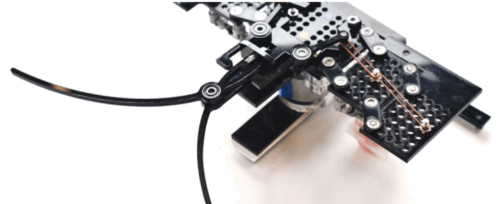
Researchers design a simple robot with intelligence programmed into its mechanical structure.
<関連情報>
- https://seas.harvard.edu/news/2025/10/programming-robots-rubber-bands
- https://www.pnas.org/doi/10.1073/pnas.2508310122#supplementary-materials
物理的に知能化された劣駆動ロボットのための再プログラム可能なシーケンス Reprogrammable sequencing for physically intelligent underactuated robots
Leon M. Kamp, Mohamed Zanaty, Ahmad Zareei, +2 , and Katia Bertoldi
Proceedings of the National Academy of Sciences Published:September 18, 2025
DOI:https://doi.org/10.1073/pnas.2508310122
Significance
Autonomous interaction with unstructured environments remains a major challenge for robots, often requiring complex control systems and multiple sensors. Here, we present a design strategy for physically intelligent, underactuated mechanisms with energy landscape that can be passively reprogrammed through mechanical contact with their surroundings. To demonstrate the concept, we develop a mechanism that passively sorts objects by mass and a four-degree-of-freedom robot that autonomously avoids obstacles. As such, this work highlights a pathway for building adaptive, low-complexity robotic systems capable of programmable intelligent behavior through mechanical design alone.
Abstract
Programming physical intelligence into mechanisms holds great promise for machines that can accomplish tasks such as navigation of unstructured environments while utilizing a minimal amount of computational resources and electronic components. In this study, we introduce a design approach for physically intelligent underactuated mechanisms capable of autonomously adjusting their motion in response to environmental interactions. Specifically, multistability is harnessed to sequence the motion of different degrees of freedom in a programmed order. A key aspect of this approach is that this order can be passively reprogrammed through mechanical stimuli arising from interactions with the environment. To showcase our approach, we construct a mechanism that passively sorts objects based on their mass and a four-degree-of-freedom robot capable of autonomously moving away from obstacles. Remarkably, these devices operate without relying on traditional computational architectures and utilize only a single linear actuator.