2025-09-19 中国科学院(CAS)
Web要約 の発言:
<関連情報>
- https://english.cas.cn/newsroom/research_news/earth/202509/t20250922_1055117.shtml
- https://www.nature.com/articles/s41467-025-63331-3
東アジアにおける更新世の陸上温暖化傾向は南極の氷床の成長と関連している Pleistocene terrestrial warming trend in East Asia linked to Antarctic ice sheets growth
Huanye Wang,Weiguo Liu,Zhonghui Liu,Xiaoke Qiang,Xinwen Xu,Jing Lei,Zhengguo Shi,Yunning Cao,Jing Hu,Fengyan Lu,Hongxuan Lu,Xiaolin Ma,Youbin Sun,Zhangdong Jin,Hong Ao,Zeke Zhang,Hu Liu,Yong Hu,Hong Yan,Weijian Zhou & Zhisheng An
Nature Communications Published:10 September 2025
DOI:https://doi.org/10.1038/s41467-025-63331-3
Abstract
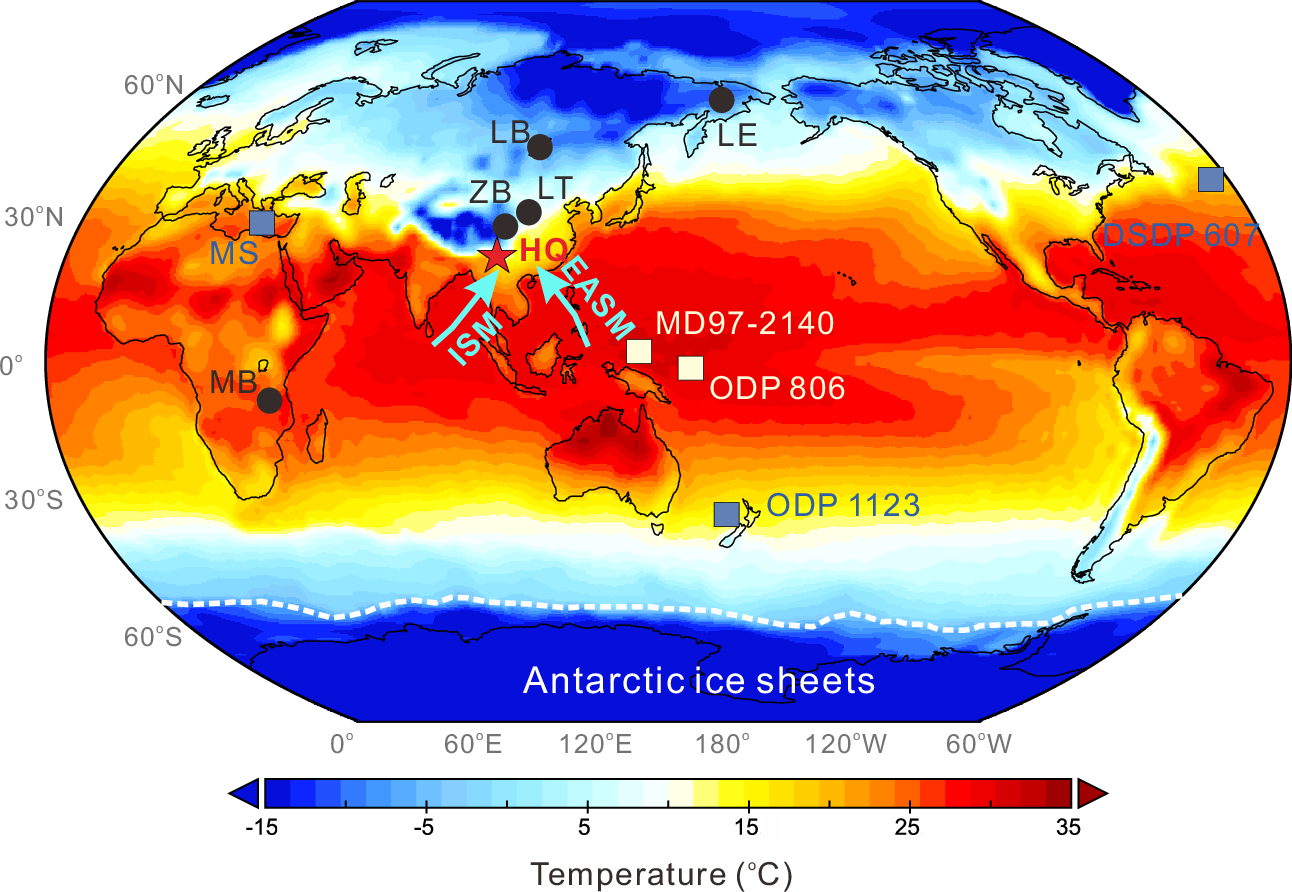
How terrestrial mean annual temperature (MAT) evolved throughout the past 2 million years (Myr) remains elusive, limiting our understanding of the patterns, mechanisms, and impacts of past temperature changes. Here we report a ~2-Myr terrestrial MAT record based on fossil microbial lipids preserved in the Heqing paleolake, East Asia. The increased amplitude and periodicity shift of glacial-interglacial changes in our record align with those in sea surface temperature (SST) records. However, its long-term warming trend (1.0 °C/Myr, 95% CI = 0.4–1.7 °C/Myr) during 1.8–0.6 Myr ago diverges from the contemporaneous SST cooling. We propose that the Pleistocene warming in East Asia primarily resulted from regionally enhanced heat input and greenhouse effect of rising water vapor driven by Antarctic ice sheets (AIS) growth, highlighting the important climatic effect of AIS evolution. Such long-term warming across the Mid-Pleistocene Transition might have been beneficial for archaic humans’ flourishing in Eurasia.