
2025-09-25 アルゴンヌ国立研究所(ANL)
<関連情報>
- https://pme.uchicago.edu/news/tiny-sensors-rapidly-detect-forever-chemicals-water
- https://www.nature.com/articles/s44221-025-00505-9
電界効果トランジスタセンサーを用いた水道水中のパーフルオロオクタンスルホン酸の可逆的なpptレベルの検出 Reversible parts-per-trillion-level detection of perfluorooctane sulfonic acid in tap water using field-effect transistor sensors
Yuqin Wang,Hyun-June Jang,Max Topel,Siva Dasetty,Yining Liu,Mohamed Ateia,Aaron Tam,Vepa Rozyyev,Ellie Ouyang,Wen Zhuang,Haihui Pu,Sang Soo Lee,Xiaoyu Sui,Jeffrey W. Elam,Andrew L. Ferguson,Seth B. Darling & Junhong Chen
Nature Water Published:25 September 2025
DOI:https://doi.org/10.1038/s44221-025-00505-9
Abstract
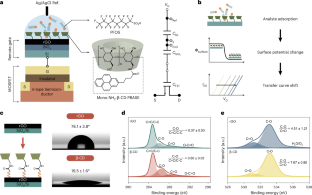
Widespread, persistent and toxic per- and polyfluoroalkyl substances (PFAS) pose a major threat to water systems and human health. Current detection methods are relatively expensive, slow and complex, underscoring the need for more accessible alternatives to meet increasingly stringent PFAS regulations. Here we present an ultrasensitive sensing platform for perfluorooctane sulfonic acid detection in tap water with a reporting limit ( ~ 250 parts per quadrillion) lower than the US Environmental Protection Agency’s regulatory standard (4 parts per trillion), using a remote gate field-effect transistor featuring β-cyclodextrin (β-CD)-modified reduced graphene oxide as the sensing membrane. The sensor exhibits excellent selectivity against common inorganic ions, natural organic matter and select organic pollutants in tap water. The reversible and rapid response ( < 2 min) indicates the potential of remote gate field-effect transistor for continuous in-line monitoring. Mechanistic studies using quartz crystal microbalance and molecular dynamics simulations reveal key roles of analyte adsorption and charge properties in sensing performance and offer insights for designing more selective PFAS capture probes.

