2025-09-05 京都大学
<関連情報>
- https://www.kyoto-u.ac.jp/ja/research-news/2025-09-05-0
- https://www.kyoto-u.ac.jp/sites/default/files/2025-09/web_2509_Katsura-2d466229328ed5ea06f854d7482c04e4.pdf
- https://www.sciencedirect.com/science/article/abs/pii/S037842902500379X
機械学習により、50 年間にわたる稲作の持続的な収穫量の要因を明らかに Machine learning reveals drivers of yield sustainability in five decades of continuous rice cropping
Tomoaki Yamaguchi, Olivyn Angeles, Toshichika Iizumi, Achim Dobermann, Keisuke Katsura, Kazuki Saito
Field Crops Research Available online :25 August 2025
DOI:https://doi.org/10.1016/j.fcr.2025.110114
Highlights
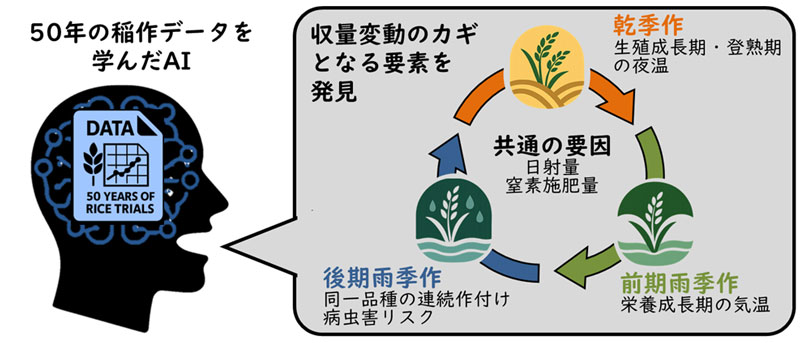
- Machine learning reveals season-specific drivers of yield in a triple-crop rice.
- Lower minimum temperatures improved yield in the dry season.
- Early wet season yield benefited from warmer temperatures during vegetative stage.
- Late wet season yield was limited by biotic stress and delayed varietal turnover.
- Season-specific management and frequent variety changes are key to sustaining yield.
Abstract
The long-term sustainability of intensive rice systems under climate change is a critical challenge for global food security. Here, we use machine learning techniques to assess the impact of climate change, genotype, and nutrient management on rice yield in the world’s longest-running continuous cropping experiment (LTCCE) at the International Rice Research Institute (IRRI) in the Philippines. In the experiment, three to six rice genotypes were cultivated from 1968 to 2017 in three annual cropping seasons—dry, early wet, and late wet seasons—with four nitrogen (N) fertilizer treatments. These genotypes were changed regularly to utilize the best high-yielding, disease- and insect-resistant varieties available at a given time. Our analysis showed that nitrogen application, varietal replacement, solar radiation, and seasonal temperature patterns were major determinants of yield variation. While nitrogen and solar radiation consistently improved yield irrespective of seasons, temperature effects were season-specific. In the dry season, lower temperatures during reproductive and ripening stages were beneficial. In the early wet season, yield gains were observed under higher vegetative-stage temperatures. Enhanced nitrogen mineralization and improved early rice growth may be contributing factors. The late wet season was constrained by low radiation, high disease pressure, and declining N response with prolonged varietal use. These findings demonstrate the value of combining long-term yield data with weather information to assess sustainability in intensive rice systems under increasing climatic and biotic pressures. They also illustrate the need for seasonally tailored and integrated crop, nutrient, and pest management practices, including more frequent variety replacement and rotating varieties between seasons. Breeding dry season varieties with reduced respiration losses and wet season varieties with improved tolerance to humid, low-radiation conditions can play a crucial role in enhancing seasonal adaptation and overall productivity.